Fact
Why your friends seem more popular
Pool every name occurrence from every friend list and well-connected people appear more often. The resulting average is never below the uniformly random-person average, and is higher when friend counts vary.
The friendship paradox comes from pooling friend-list entries: well-connected people appear more often, so the pooled-entry average is at least the random-person average and is higher when friend counts vary.
By the Math Says Yes editorial team
Human-reviewed under our source and correction standards.
How we review content
THE TRAP
We picture a symmetric swap — if your friends count you, you should count them just as much. But friendship counting is weighted by how connected each person is, and that weighting tips the comparison.
What the paradox says
Take everyone in a social network, ask each person how many friends they have, and those counts. Now list every name on every person's friend list and average the friend-counts attached to those names. This is the same as choosing a uniformly random endpoint of a friendship. The second average is always at least as large as the first because people with more connections appear more often. This is an aggregate sampling result, not a promise that every individual's friends are more connected.
What the Numbers Show
2.4 friends
pick a random person
3.3 friends
follow a random friendship
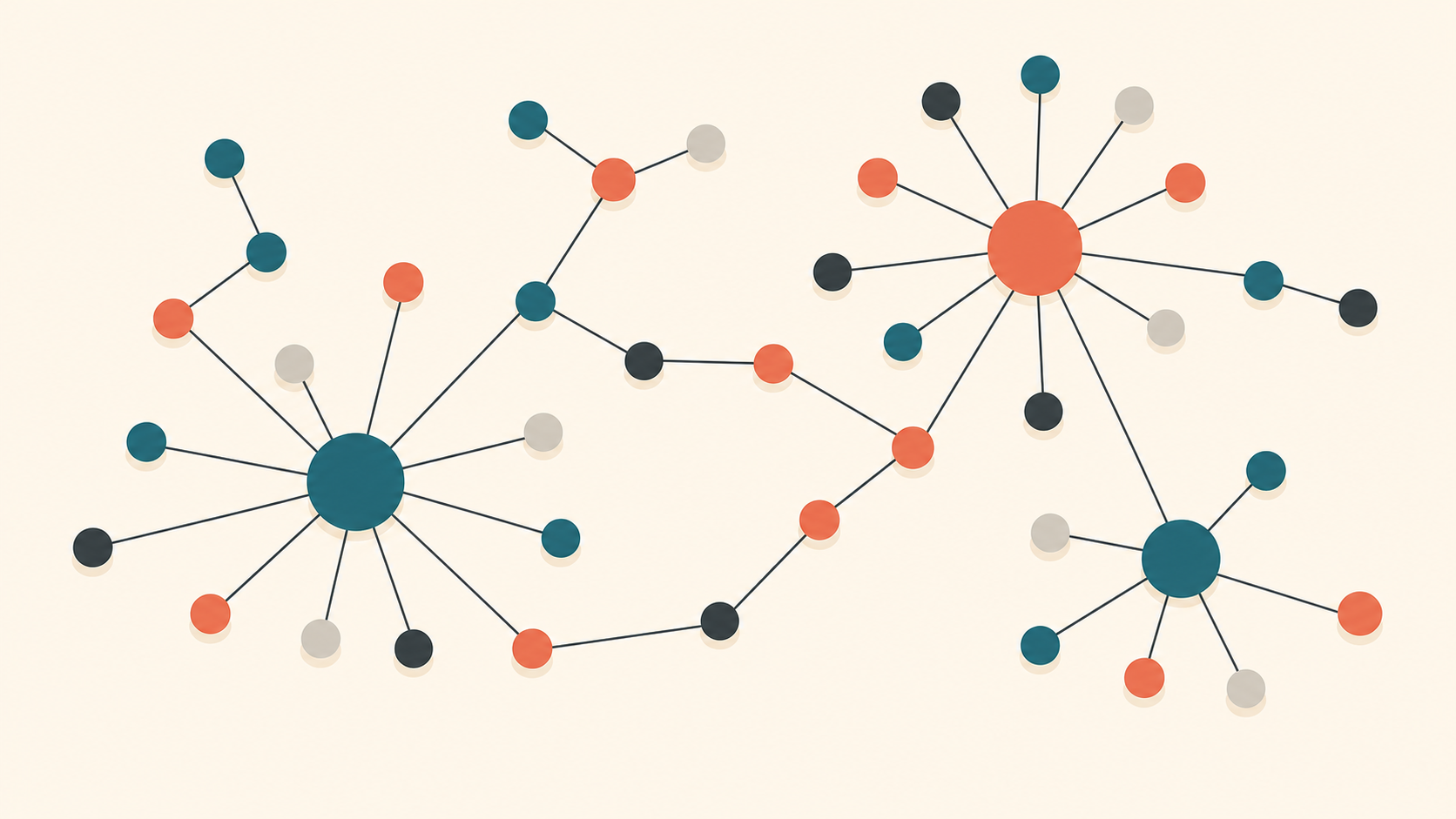
Illustrative network. The large coral hubs sit on many links, so sampling through friendships counts them again and again.
Why it happens
The cause is in the counting, not in who is liked. A person with many friends appears once per friendship when every list entry is pooled. Every connection is another to be picked, so this method over-samples the well-connected. That is size-biased sampling: the pooled-entry cannot fall below the random-person average and rises above it when friend counts differ.
Why intuition fails
Our instinct treats friendship as a clean, symmetric trade: if you count someone, surely they count you the same. So we expect the two averages to match. The hidden move is that the comparison is weighted by connectivity. A hub with dozens of friends gets to push their high friend-count into dozens of other people's lists, while a person with two friends barely appears anywhere. The averaging is not over people evenly; it is over connections, and connections cluster on the popular.
Where it shows up
Whenever you through undirected links instead of sampling nodes uniformly, high-degree nodes receive more chances to appear. That can affect summaries of friends, co-authors, collaborators, airports, or contacts. Social feeds add other filters — who posts, how often, engagement, and ranking — so the theorem explains one possible selection effect, not every difference you see.
How to use it
The can also be useful. Asking randomly selected people to name a contact tends to reach more-connected people without mapping the entire network, which motivates acquaintance-based immunization and network-sampling strategies. It raises the of finding hubs; it does not guarantee that every nominated contact is a hub or that a message will travel fastest.
Worked example
Use a four-person star: one centre person is friends with each of three leaves, while each leaf is friends only with the centre. The degrees are [3, 1, 1, 1]. A uniformly random person has (3 + 1 + 1 + 1) / 4 = 1.5 friends on . A uniformly random friendship endpoint — equivalently, a random name from all friend lists — has (3² + 1² + 1² + 1²) / (3 + 1 + 1 + 1) = 2.0 friends on average. The centre appears three times among the six friend-list names, so friendship sampling raises the mean from 1.5 to 2.0.
What people get wrong
You compare yourself with the friends you can see, and the comparison feels fair. It is not. Your friends are not a of people. People with many connections are more likely to appear in anyone's friend set, so the visible social world can look more connected, active, or popular than the person really is.
When it applies
The endpoint identity applies directly to undirected networks such as mutual friendships or collaboration links. It is useful when a process samples through links rather than sampling nodes uniformly. Directed follower or citation networks need separate in-degree and out-degree definitions. None of these versions means every friend is more connected than you.
Source note
Feld's American Journal of Sociology paper is the primary source for the friendship paradox. It supports the page's core claim that network sampling makes friends appear more connected on because people with many ties are encountered more often.
Try It
The friendship paradox
Pool every friend-list entry: larger dots appear once per link.
2.9
random person avg
3.6
pooled list-entry avg
Every link contributes one name occurrence at each end. Pool those entries and larger hubs get more chances to be sampled, so the entry average is at least the person average — and higher when degrees vary.
FAQ
Why do my friends have more friends than I do?
Because pooling all friend-list entries over-counts the well-connected. Someone with many friends appears once per friendship, so a uniformly random pooled entry is more likely to be that person. Its average is at least the random-person average and is higher when friend counts vary; this does not guarantee the same comparison for you individually.
Is the friendship paradox always true?
For a network with at least one friendship, the endpoint mean equals the sum of squared friend-counts divided by the sum of friend-counts. It is always at least the uniformly random-person mean and is strictly higher whenever friend-counts are not all equal. It is not true for every individual, though — someone more connected than all their friends is a perfectly possible exception. The claim is about the sampling average, not about you specifically.
Quick Check
Why can a name pooled from all friend lists look more popular than a random person?
A
Most people have fewer friends than they think.
B
People tend to choose less popular friends.
C
Popular people appear in many friend-lists.
Sources
Friendship paradox
Secondary explainer
Wikipedia · Accessed 2026-06-15
Why your friends have more friends than you do
Primary source
American Journal of Sociology · Accessed 2026-06-20
Know someone who'd like this?
Read next

Publication bias hides the studies that found nothing
If only exciting results get published, the visible research record can make an effect look cleaner and stronger than it really is.
Concepts
Sampling Bias
A distorted result caused by looking at data that does not represent the population you care about. More data does not fix the problem if the same kinds of cases are still missing. Before trusting a conclusion, ask who had a chance to appear in the sample and who was left out.
Size-Biased Sampling
A way of sampling where an item's chance of being picked grows with its size or its number of connections, so larger or more-connected items are over-represented. It is why a name occurrence pooled from every friend list looks more popular than a random person: well-connected people appear in many lists, so they get drawn more often. The same effect makes classes feel bigger when you ask students than when you ask the registrar, because more students sit in the large classes.