Fact
A three-point poll lead can still be a tie
If a poll says 51% versus 48% with a plus-or-minus 3 point margin of error, the headline leader may not really be ahead.
Margins of error remind us that poll numbers are estimates. When uncertainty ranges overlap, the apparent ranking can be too close to call.
By the Math Says Yes editorial team
Human-reviewed under our source and correction standards.
How we review content
THE TRAP
Reading the bigger point estimate as a definite lead and ignoring the plus-or-minus uncertainty around both estimates.
Poll numbers are estimates
A poll asks a of people and uses that sample to estimate what a larger thinks. The reported percentages are not exact measurements of the population. If a different random sample had been drawn, the percentages would usually shift a little. The is the pollster's way of showing the size of that ordinary sampling wobble.
What the Numbers Show
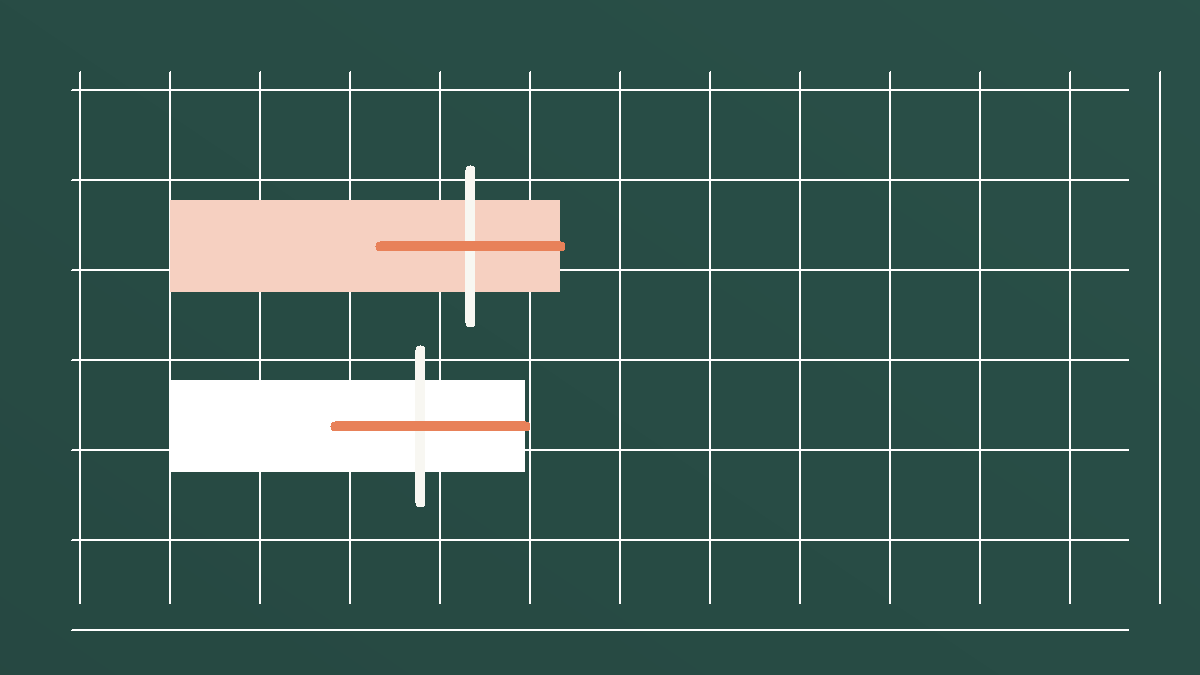
A (51%) could really be at
48%
B (48%) could really be at
51%
Illustrative: a 51–48 result with ±3-point uncertainty can still be tied or reversed.
The tie hidden inside the lead
Suppose one side is at 51% and the other is at 48%, with a of plus or minus 3 percentage points. The first estimate could plausibly be around 48% to 54%, while the second could plausibly be around 45% to 51%. Those ranges overlap. The 's point estimate has a leader, but the uncertainty still leaves room for a practical tie or even a reversed order.
Why headlines overstate it
Rankings make simple stories: ahead, behind, winner, loser. Uncertainty makes messier stories: maybe ahead, maybe tied, maybe too close to call. The simple story is easier to headline, so point estimates get treated like exact scores. That turns noise into drama. The is not a footnote for statisticians; it is part of the result and should shape the headline.
How to use it
When reading a poll, compare the uncertainty ranges, not just the point estimates. Treat small leads inside the as uncertain. Also remember that the margin of error covers only random ; it does not automatically fix nonresponse, bad weighting, question wording, or turnout assumptions. A good poll is evidence, but it is still evidence with a range around it.
Worked example
A poll can report Candidate A at 51% and Candidate B at 48%, a three-point lead. If the uncertainty around each estimate is roughly three points, the headline lead is smaller than the ordinary sampling uncertainty around the estimates. The exact uncertainty around the difference can depend on the poll design, but the practical reading is the same: the point estimate has an order, while the evidence is still too close to call confidently.
When it applies
is useful for random sampling uncertainty, not for every polling problem. Turnout modeling, question wording, late opinion changes, nonresponse, weighting, and mode effects can all move the result. Treat the published margin as one visible piece of uncertainty. A responsible reading combines it with poll quality, trend, composition, and whether other polls show the same direction.
What people get wrong
People read the poll like a scoreboard: 51 beats 48, so one side is winning. Polls are estimates, not final scores. A small lead can be the best single estimate and still not be strong evidence of a real lead once sampling uncertainty and other survey errors are included.
Source note
The Dominitz and Manski source is used because it broadens the discussion from the familiar sampling to total survey error. That is the quality point for this page: a close poll lead can be uncertain even before considering non-, and real polling uncertainty is often larger than the simple number in a graphic.
FAQ
Does margin of error include every possible polling mistake?
No. The usual margin of error reflects random sampling uncertainty. Other errors, such as nonresponse, likely-voter modeling, wording, and weighting, can still matter.
Can a poll leader inside the margin of error still win?
Yes. The point estimate may still be the best single estimate. The point is that the evidence is not precise enough to treat the lead as certain.
Quick Check
A poll shows 51% versus 48% with a plus-or-minus 3 point margin of error. What is the safest reading?
A
The race may be effectively tied.
B
The margin of error only applies to the smaller number.
C
The 51% side is guaranteed to be ahead.
Sources
Margin of error
Secondary explainer
Wikipedia · Accessed 2026-06-16
Using Total Margin of Error to Account for Non-Sampling Error in Election Polls: The Case of Nonresponse
Primary source
arXiv · Accessed 2026-06-20
Know someone who'd like this?
Read next
A 95% confidence interval is not a 95% promise
A 95% confidence interval means the method works 95% of the time in repeated samples, not that this exact range now has a 95% chance of holding the truth.
Concepts
Confidence Intervals
A confidence interval is a range produced by a method that captures the true value a stated share of the time across repeated samples. It describes uncertainty in the estimating method, not a personal guarantee that one already-computed interval contains the truth.
Margin of Error
A margin of error is the plus-or-minus range around a survey estimate caused by sampling uncertainty. If two estimates have overlapping uncertainty ranges, the apparent leader may not be truly ahead.