Fact
Earth may have more trees than the Milky Way has stars
A 2015 Nature study estimated about 3.04 trillion trees on Earth, far above common estimates for stars in the Milky Way.
The comparison is a lesson in scale, measurement, and uncertainty, not a single perfect number.
By the Math Says Yes editorial team
Human-reviewed under our source and correction standards.
How we review content
THE TRAP
Space feels bigger than Earth, so the star count feels like it must win. But the comparison is between one galaxy's stars and one planet's trees.
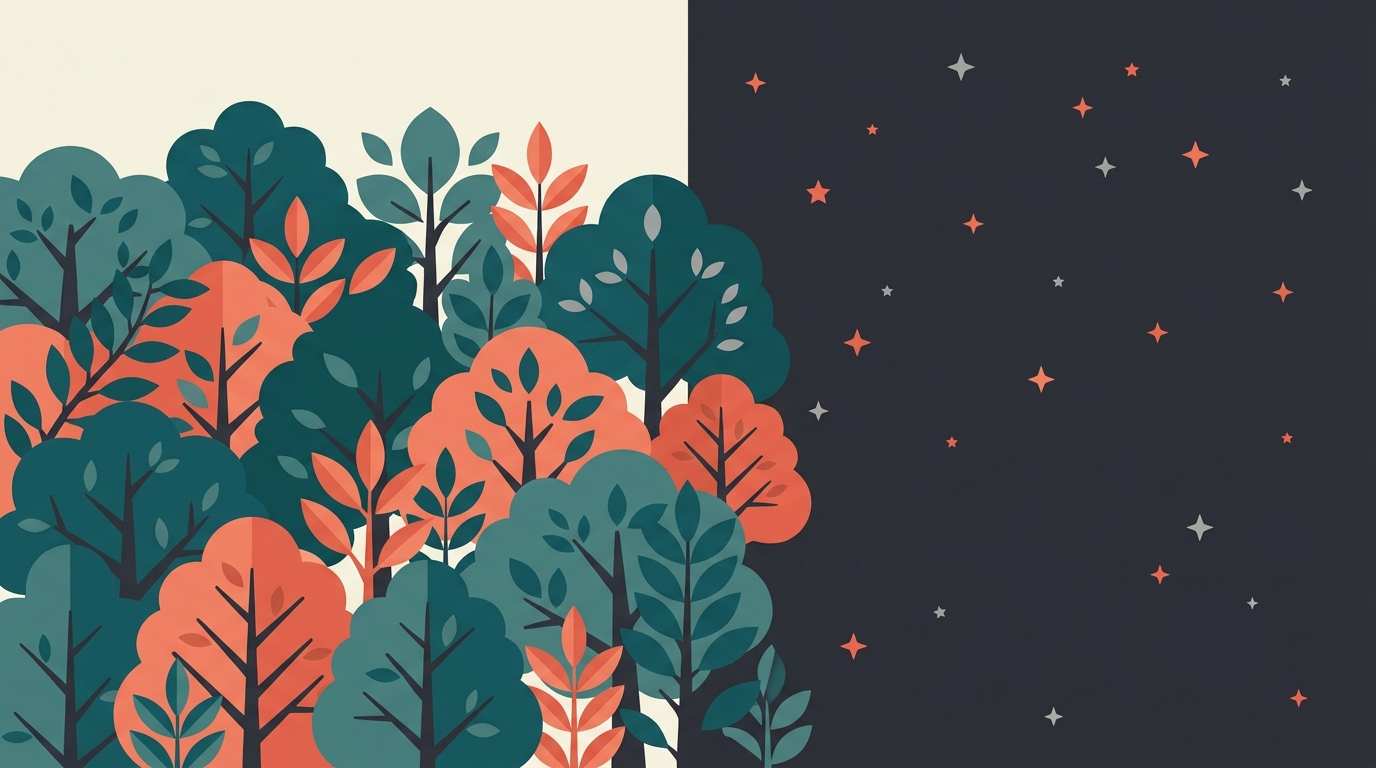
What this shows
Earth's 2015 tree estimate is about 3.04 trillion — that is 3,040 billion. Common Milky Way star estimates are often given as a range around 100 to 400 billion. Put in the same unit, the tree estimate is still several times larger than the upper end of that star range. The useful lesson is scale with uncertainty, not a perfect final count.
What the Numbers Show
Trees on Earth
3,040
Milky Way stars
400
Counts in billions: ~3,040 (3.04 trillion) trees vs the upper end of a common ~100-400 billion estimate for Milky Way stars.
Source: Mapping tree density at a global scale · Milky Way
Why intuition fails
Intuition hears space and silently upgrades the question to the whole universe. But the claim is narrower: one planet's trees versus one galaxy's stars. Intuition also struggles with the gap between billion and trillion. A trillion is one thousand billions, so 3.04 trillion trees means 3,040 billion trees. Once the units are aligned, the surprising comparison becomes easier to inspect instead of just feeling impossible.
Worked example
Put roughly 3 trillion trees on Earth next to roughly a few hundred billion stars in the Milky Way, and the tree count is several times larger even at the generous end of the star range. Neither side was counted one by one. The tree number came from combining ground measurements with spatial modeling to estimate global tree density; the star number is also indirect, estimated by astronomers from observations and models. That makes the phrase "may have more" important: the comparison is well supported at the order-of-magnitude level, but both quantities depend on definitions, measurement limits, and modeling choices.
How to use it
When a big-number claim sounds unbelievable, normalize the units first. Convert trillions to billions, compare ranges rather than single numbers, and ask how each estimate was produced. If the conclusion still holds against a conservative end of the range — as the tree-versus-star comparison above does — it is much more useful than a trivia fact.
What people get wrong
People hear "galaxy" and assume any number attached to it must dwarf anything on Earth, but scale does not work by category label: stars are enormous and sparse, while trees are tiny and densely packed across whole continents, so counting objects is not the same as comparing physical size. The other misreading stretches the claim. It does not say Earth has more trees than the universe has stars, and it does not say either count is exact. It says a current global tree estimate is larger than common estimates for stars in the Milky Way — and that wording preserves the uncertainty.
When it applies
This fact is useful for teaching orders of magnitude and denominator choice. It should not be read as an exact census. Tree estimates depend on definitions, land cover, and measurement methods; star estimates depend on models and detection limits. The point is to compare approximate scales honestly, not to pretend either total is exact.
Source note
The global tree estimate comes from the Nature tree-density study. The Milky Way star count is treated as a broad astronomical background estimate, not a precise measured total. This page should keep its language approximate because both sides of the comparison are model-based counts.
FAQ
Is this actually true?
It is true as an estimate-based comparison. A 2015 Nature study estimated about 3.04 trillion trees on Earth, while common Milky Way star estimates are often around 100 to 400 billion. Because both sides are estimates, the careful wording is that Earth may have more trees.
Why not give one exact number?
Neither trees nor stars are counted directly at that scale. Tree estimates depend on field samples, definitions, and models of tree density. Milky Way star estimates depend on astronomical observations and assumptions. A range is more honest than pretending one exact integer is known.
What is the useful takeaway?
Use the same units and compare ranges. Converting 3.04 trillion trees into 3,040 billion trees makes the relationship visible. The result is less about winning a trivia contest and more about treating large estimates with the right amount of uncertainty.
Quick Check
What is the real lesson of comparing Earth's trees to the Milky Way's stars?
A
There are exactly more trees than stars, with no uncertainty.
B
Huge counts are estimates with ranges and methods, not single exact integers.
C
Space is actually smaller than the Earth.
Sources
Mapping tree density at a global scale
Primary source
Nature · Accessed 2026-06-13
Milky Way
Secondary explainer
Wikipedia · Accessed 2026-06-14
Know someone who'd like this?
Read next
A 95% confidence interval is not a 95% promise
A 95% confidence interval means the method works 95% of the time in repeated samples, not that this exact range now has a 95% chance of holding the truth.