Fact
A million seconds vs a billion seconds
A million seconds is about 12 days. A billion seconds is about 32 years.
A billion is a thousand millions, a gap our intuition collapses into 'both are just big'.
By the Math Says Yes editorial team
Human-reviewed under our source and correction standards.
How we review content
THE TRAP
Both just sound like 'unimaginably big', so we file them together, but one is literally a thousand times the other.
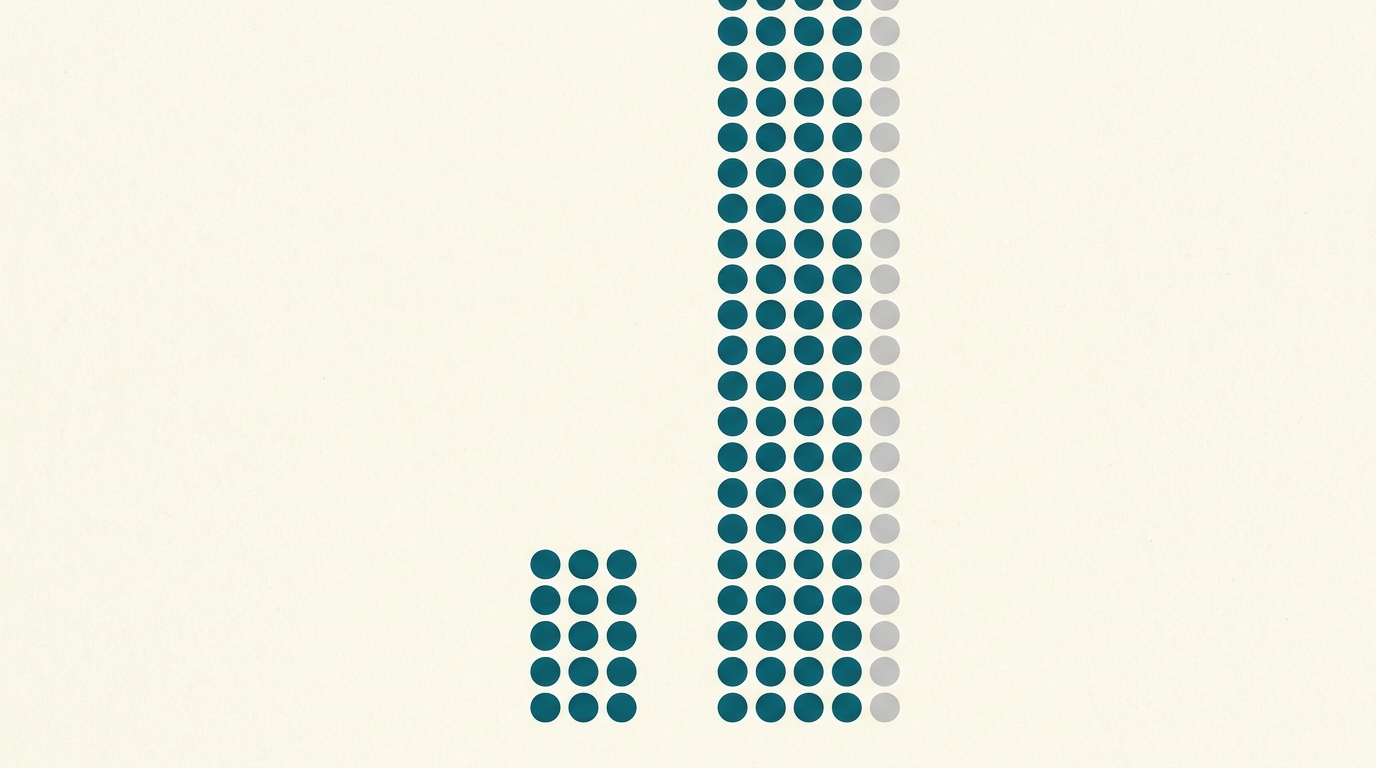
What this shows
A million is 10^6 (1,000,000). A billion is 10^9 (1,000,000,000). That three-zero difference means a billion is one thousand millions, not just a slightly bigger million. The seconds conversion makes the gap physical: one million seconds fits into less than two weeks, while one billion seconds reaches across decades. Writing the full numbers makes the hidden scale much harder to miss.
What the Numbers Show
A million seconds
12
A billion seconds
11,574
Counted in days: a million seconds ≈ 12 days; a billion seconds ≈ 11,574 days (about 32 years).
Source: Orders of magnitude (time) · Metric (SI) prefixes
Why intuition fails
Million, billion, and trillion sound like neighboring labels, so the mind files them into a single bucket called huge. Our intuition is built for small counts and direct comparisons; once numbers pass everyday experience, it stops telling them apart. They are not evenly spaced steps in feeling; they are thousandfold jumps in quantity. A familiar unit such as days or years forces the hidden multiplier back into view.
Worked example
There are 86,400 seconds in a day. Divide 1,000,000 by 86,400 and you get about 11.6 days. Divide 1,000,000,000 by 86,400 and you get about 11,574 days, or roughly 31.7 years. The words differ by only one letter, but the quantities differ by a factor of 1,000. Counting one number per second, a million is a short wait. A billion is a large slice of a human life.
How to use it
When a number is too large to feel, convert it into a rate-based story. Seconds become days or years. Money becomes cost per person. Distance becomes travel time. Also ask how many of the smaller number fit inside the larger one. That one question — how many millions are in a billion? — often reveals the missing scale immediately.
What people get wrong
Budgets, company valuations, counts, time scales — wherever the zeros pile up, people compare the words instead of the quantities. A million and a billion get filed under the same label, 'very large', even though 1,000,000 and 1,000,000,000 differ by a factor of 1,000. When the words blur together, write the full numbers or count the groups of three zeros.
When it applies
This comparison is useful whenever public numbers get too large to imagine: government spending, climate quantities, user counts, data storage, or astronomical distances. It is a scale translator, not a policy argument. The right comparison unit depends on the decision: seconds, years, dollars per person, truckloads, or percentages of a total.
Source note
The NIST SI-prefix source anchors the metric scale vocabulary behind million, billion, and other powers of ten. The seconds-to-days and seconds-to-years comparisons are simple unit conversions used to make the order-of-magnitude gap easier to inspect.
Try It
Million vs billion seconds
Step through powers of ten and feel the scale.
Selected scale
10^6 = 1,000,000 seconds
11.6 days
Power-of-ten ladder
Each row is 10× the one above
1,000×
A billion seconds contains one thousand million-second blocks: about 31.7 years instead of 11.6 days.
10^6 seconds is 11.6 days. Each step multiplies the total by ten, so a billion seconds isn't slightly more than a million — it's a thousand times longer.
FAQ
How long is a million seconds?
A million seconds is about 11.6 days. Rounded for memory, that is about 12 days, or less than two weeks. The calculation is 1,000,000 divided by 86,400 seconds per day.
How long is a billion seconds?
A billion seconds is about 11,574 days, or roughly 31.7 years. Rounded for intuition, it is about 32 years. That is exactly one thousand times longer than a million seconds.
What is the practical lesson?
Translate large numbers into familiar units and ask how many smaller units fit inside the larger one. A billion is not a little above a million; it is one thousand millions.
Quick Check
A million seconds is about 12 days. A billion seconds is about:
A
4 months
B
12 weeks
C
32 years
D
1,000 days
Sources
Metric (SI) prefixes
Authoritative source
National Institute of Standards and Technology · Accessed 2026-06-20
Orders of magnitude (time)
Secondary explainer
Wikipedia · Accessed 2026-06-14
Know someone who'd like this?
Read next
The last sticker costs the most
Completing a set of N collectibles takes far longer than N tries — the final few items hide behind a wall of duplicates, and the expected number of packs is about N·ln N.