Fact
The last sticker costs the most
Completing a set of N collectibles takes far longer than N tries — the final few items hide behind a wall of duplicates, and the expected number of packs is about N·ln N.
Duplicates do the damage: once you own most of the set, nearly every pack repeats something you already have, so the last few stickers cost more than the whole start of the album.
By the Math Says Yes editorial team
Human-reviewed under our source and correction standards.
How we review content
THE TRAP
We plan for “N items, so a bit more than N tries” and ignore how fast duplicates pile up near the end.
What this shows
Collecting every item in a set of N, where each try gives you a uniformly random item, does not take about N tries. It takes roughly N times the natural logarithm of N, plus a small extra term of about 0.577 times N. For a 50-item set that works out to around 225 tries on , more than four times the size of the set itself. The shortfall comes entirely from duplicates: once you own most of the set, the overwhelming majority of draws repeat something you already have, so each new unique item arrives more and more slowly.
What the Numbers Show
10
25
50
100
200
400
unique stickers
single-sticker draws →
For a 50-item set with 1 item per draw, half arrives in about 34 draws; completion averages about 225.
Why the tail is brutal
Imagine you have N minus one of the N items, with a single gap left. Each pack is now the one you need with just 1 over N, and everything else is a duplicate — the cost is concentrated at the very end. A chance of 1 in N means the expected number of tries to finally land that item is about N all by itself. So the last single item can cost as many tries as the entire set has members. The second-to-last costs about N over two, the one before that about N over three, and so on, which is exactly where the logarithm in the total comes from.
Why intuition fails
Most people mentally budget for something close to N tries, maybe a bit more, because the set has N slots and each try fills a slot. That picture quietly assumes every draw is useful, but draws stop being useful as the album fills. We notice the early rush, when nearly every pack adds a sticker, and we forget that the same randomness will hand us duplicate after duplicate later. The gap between the N we expect and the N·ln N we actually pay is the whole surprise, and it grows with the size of the set.
Worked example
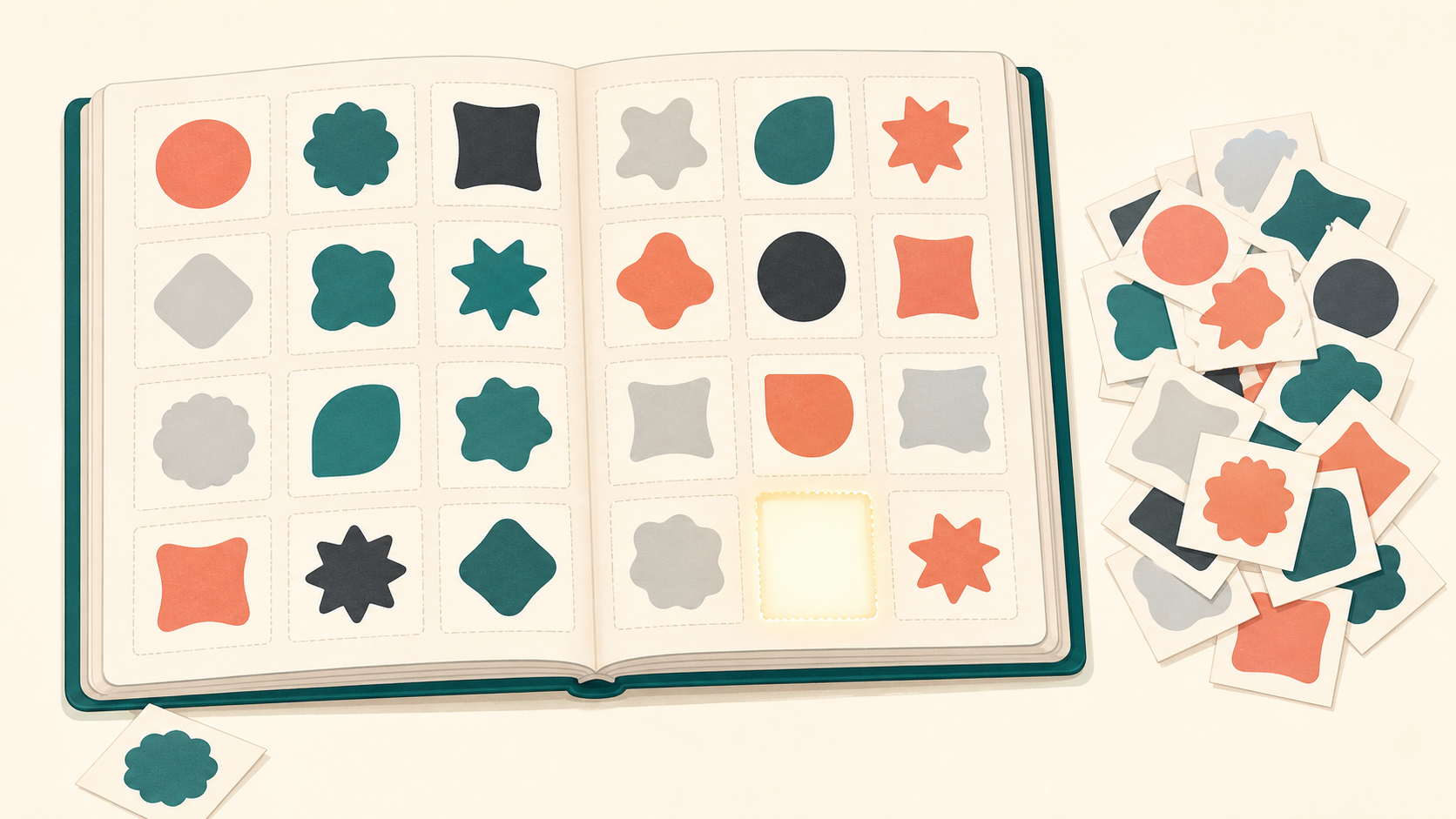
Take a sticker album with 50 distinct stickers, each pack a uniformly random one. On it takes about 225 packs to fill the whole album. The first half of the album, the first 25 stickers, arrives surprisingly fast, in roughly the first 34 packs. After that the pace collapses. The final sticker averages about 50 packs on its own, and the last handful together account for a large share of the total. The chart traces this: the line shoots up early, then flattens into a long, slow crawl toward the last slot.
How to use it
Whenever you must collect every item from a fixed set and the items arrive at random, plan for the tail, not the count. Set your budget closer to N·ln N than to N, and expect the last few items to dominate the effort. Better still, trade. Swapping duplicates with another collector collapses the slow tail, because your surplus is exactly someone else's gap. That is why sticker-swap culture exists: a market of traders turns the brutal individual finish into a quick collective one, and it is the cheapest way to beat the math.
What people get wrong
A collector holding 40 of an album's 50 stickers feels 80% done, yet has spent only about a third of the expected packs. Budgeting too few tries is the instinct you start with; this mistake comes later, mid-collection: reading the share of items owned as the share of effort spent. Random collecting is front-loaded — early progress is easy because many outcomes help, late progress is slow because only a few do. The same number of remaining items can hide a much larger expected wait.
When it applies
The coupon-collector pattern appears in sticker albums, loot boxes, testing rare bugs, finding all categories in logs, collecting survey responses from every segment, or seeing every variant in randomized systems. It fits best when outcomes are sampled randomly with replacement. Trading, targeting, or unequal probabilities change the wait.
Source note
The authoritative treatment of the coupon collector's problem is Wolfram MathWorld's. The page uses the formal result as intuition: the expected time is driven by the increasingly slow search for the last unseen categories.
Try It
Coupon collector
Open packs and watch the last few stickers stall.
0%
% complete
0
packs opened
91
expected to finish
The first stickers come fast, but near the end almost every pack is a duplicate — the last item alone takes about as many packs as the whole set has items.
FAQ
Why is the last item in a collection so hard to get?
Because once a single item is missing from a set of N, each random draw is the one you need only with probability 1 over N. That small chance means the expected wait for that final item is about N tries all by itself.
How many packs does it take to finish an N-item set?
On average about N times the natural logarithm of N, not N. For a 50-item set that is roughly 225 packs, more than four times the size of the set, because duplicates dominate the later draws.
Quick Check
You have 49 of 50 stickers. With 1 random sticker per draw, how many more draws until the last one, on average?
A
About 50 draws.
B
About 2 draws.
C
About 5 draws.
Sources
Coupon Collector's Problem
Authoritative source
Wolfram MathWorld · Accessed 2026-06-20
Coupon collector's problem
Secondary explainer
Wikipedia · Accessed 2026-06-15
Know someone who'd like this?
Read next

Insurance is a bet you want to lose
On average you pay in more than you ever get back. Buying it is still the smart move.