Fact
Insurance is a bet you want to lose
On average you pay in more than you ever get back. Buying it is still the smart move.
Expected value says you'll lose a little most years; insurance is worth it because it caps a loss you couldn't survive.
By the Math Says Yes editorial team
Human-reviewed under our source and correction standards.
How we review content
THE TRAP
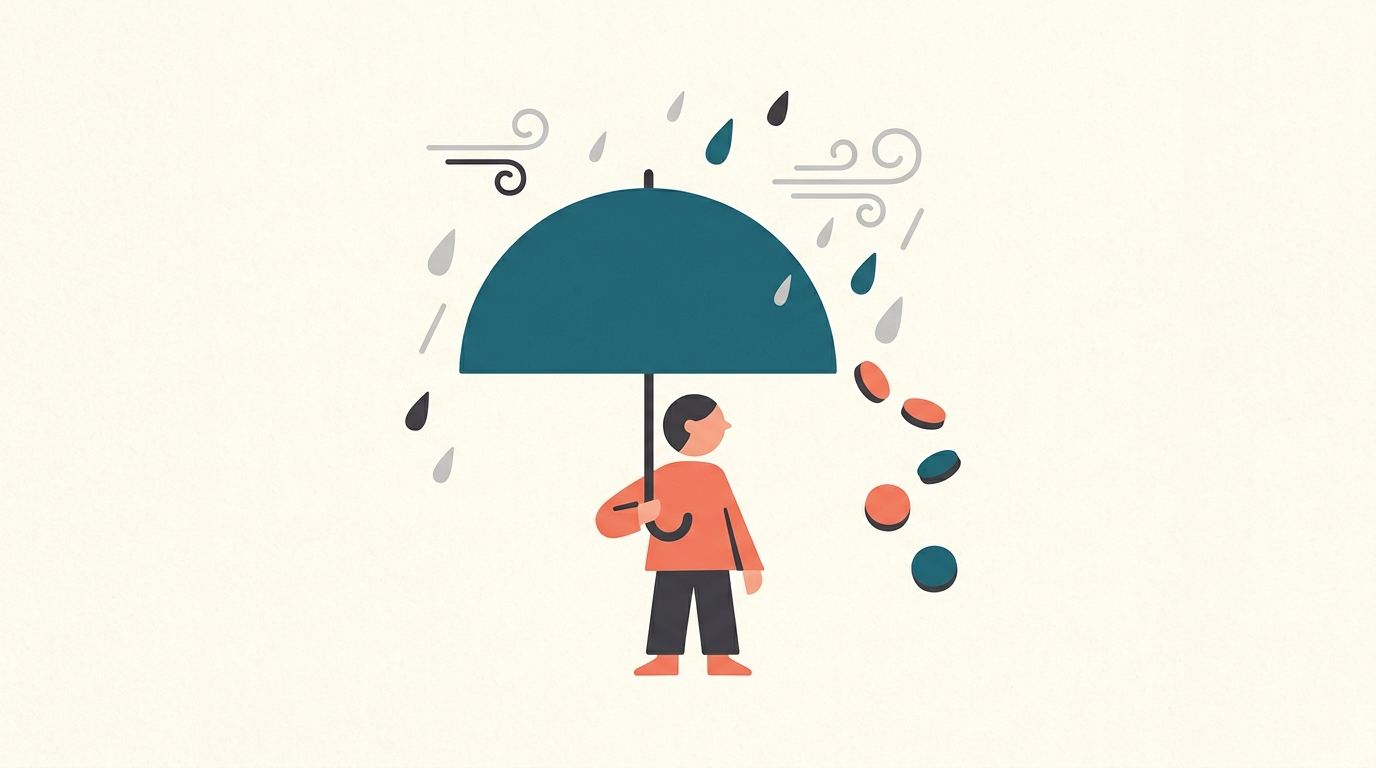
A negative average makes insurance look like a bad deal, but the average ignores the loss that would wipe you out.
What this shows
Buying insurance is, on , a losing bet, and it can still be the right call. The math term is , the -weighted average outcome, and it is not the only thing a decision can depend on. Insurance often has negative expected value for the buyer because premiums include administration, reserves, and profit. People still buy it rationally when the covered loss would be too large to absorb. Winning money was never the goal: insurance trades a rare catastrophic loss for a predictable smaller cost.
What the Numbers Show
Yearly premium
1,200
A disaster, uninsured
300,000
You'll likely "lose" the ~1,200 premium most years, but it caps a ~300,000 loss you could not absorb.
Why intuition fails
If you could play the same small gamble thousands of times, only the would matter — treats repeated, survivable bets cleanly. Insurance decisions are different because the dangerous outcome may happen once and be too large to survive financially. The pain of losing 300,000 is not just 250 times the pain of losing 1,200. Money has context: rent, debt, recovery time, and whether you can continue after the loss.
Worked example
Imagine a yearly premium of about 1,200 that protects against a 300,000 disaster. If the disaster has roughly a 1-in-300 of striking this year, your expected loss is about 1,000 — the premium costs more, so on you lose by buying. In most years there is no payout, and the policy feels like money thrown away. But the bad year is not just a bad score in a game; it may be a loss that destroys savings, forces debt, or cannot be recovered from. The insurer can pool many independent risks and rely on averages. You may have only one house, one body, and one savings account.
How to use it
Use two filters together. First, ask about : what would this cost on over many similar cases? Second, ask about survivability: could I handle the bad outcome without protection? Insurance is strongest for rare, severe, unaffordable losses. For small losses you can comfortably absorb, self-insuring may make more sense than paying someone else to smooth the risk.
What people get wrong
Wanting to 'win' against the insurer is the tell: if your policy ever pays out more than you paid in, something bad happened to you. The value of insurance is risk transfer, not beating the company at . From there, two opposite errors remain. One is treating all negative-expected-value purchases the same — some are just expensive bets, others buy protection against ruin. The reverse is assuming every insurance product is automatically worth buying. The useful question is specific: does this policy transfer a loss that would be severe for you, at a price you can justify?
When it applies
Insurance makes most sense for losses that are rare, large, and hard to absorb alone: liability, health shocks, house fires, disability, or major car crashes. It makes less sense for small routine costs you can comfortably pay yourself. The question is not only ; it is whether the bad outcome would break your plan.
Source note
The practical description of insurance as pooling and transferring risk comes from the Insurance Information Institute. The expected-value source supports the mathematical framing, while this page adds the decision point: risk reduction can be worth paying for even when the payout is lower than the premium.
Try It
Insurance simulation
Simulate 2,000 years of paying in or bearing the risk.
—
avg/yr with insurance
—
avg/yr without insurance
—
worst year with
—
worst year without
In this example, the premium is $1,200/yr and a disaster (prob 0.3%) costs $300,000. On average, the uninsured person pays ~$900 — they 'win' the bet. But their worst year can be catastrophic ($300,000). Insurance caps that tail at the cost of a small, predictable loss every year ($1,200). Numbers are illustrative.
FAQ
Why buy insurance if the expected value is negative?
Because expected value is an average, not a survivability test. A policy can cost more than the expected payout and still be rational if it protects you from a rare loss that would be financially devastating.
When is insurance most useful?
It is most useful for low-probability, high-severity losses that you could not comfortably absorb yourself. It is usually less compelling for small, frequent losses where the premium mainly buys convenience.
What does "a bet you want to lose" mean?
It means the good outcome is paying the premium and never needing the payout. A claim may return money, but only because something bad happened. Losing the bet means the disaster did not occur.
Quick Check
Why buy insurance if, on average, you pay more than you get back?
A
Premiums are refunded if unused
B
It caps a rare loss you couldn't survive
C
It has a positive expected value
D
You always come out ahead
Sources
Expected value
Secondary explainer
Wikipedia · Accessed 2026-06-14
How insurance works
Authoritative source
Insurance Information Institute · Accessed 2026-06-20
Know someone who'd like this?
Read next

The last sticker costs the most
Completing a set of N collectibles takes far longer than N tries — the final few items hide behind a wall of duplicates, and the expected number of packs is about N·ln N.