Lesson
The Average Isn't the Whole Story
Expected value ignores how badly the rare outcome would hurt.
By the Math Says Yes editorial team
Human-reviewed under our source and correction standards.
How we review content
Expected value averages outcomes
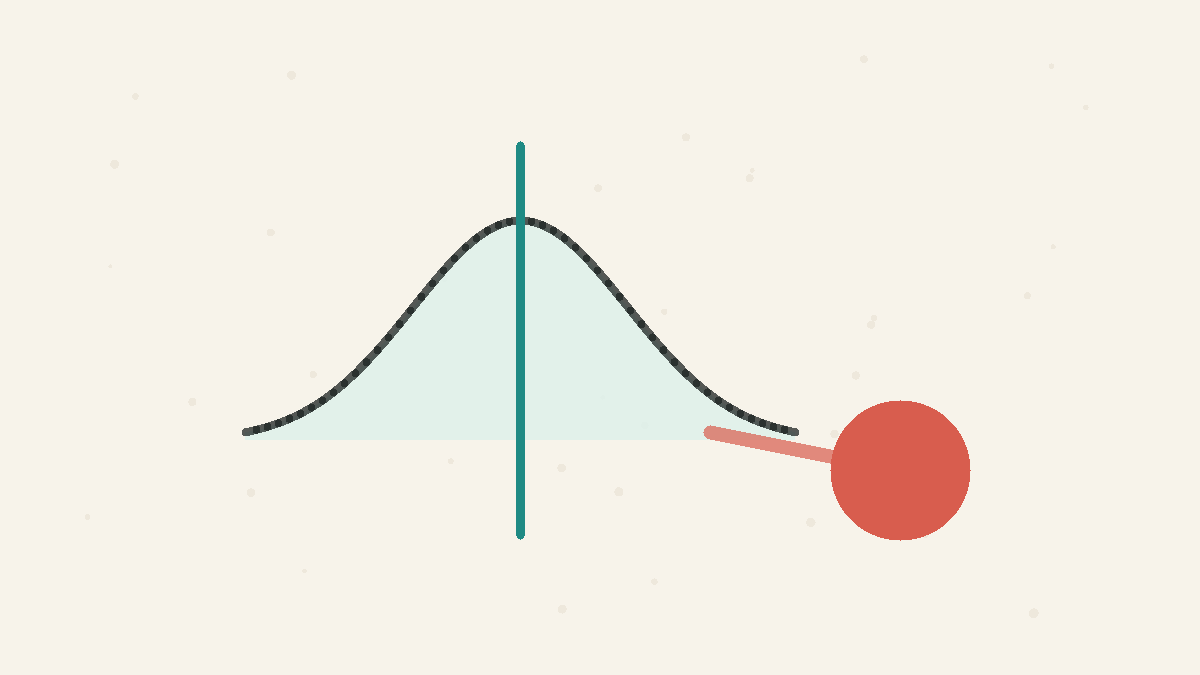
multiplies each outcome by its and adds the results. It is the right lens for repeatable decisions where losses are small enough to survive and gains or losses can out over time. A casino can rely on expected value because it sees many bets. A person making one high-stakes decision cannot always rely on the same average because there may be no second attempt.
Variance is the missing dimension
Two choices can have the same and very different risk. One might produce a steady small result. Another might usually do nothing and rarely produce a devastating loss. The treats both through -weighted arithmetic, but lived consequences are not averages. tells you how widely outcomes can swing. For personal finance, safety, health, and business survival, that swing can matter more than the mean.
Why insurance can be rational
Insurance often has a negative for the buyer: on , you pay more than you receive. Yet it can still be rational because it trades a rare catastrophic loss for a predictable smaller cost. Nobody buys a policy to beat the insurer on average; you buy it to survive an outcome you could not absorb. Expected value alone misses that survival constraint.
Separate repeatable from ruinous
Before using , ask whether the decision is repeatable, whether losses are capped, and whether you can survive the bad outcome. If the answer is yes, expected value is powerful. If the answer is no, look at worst-case exposure, cash reserves, downside limits, and recovery time. A positive is not enough when one bad draw can remove you from the game entirely.
FAQ
When is expected value the right tool?
It is strongest for repeatable, independent, survivable decisions where many outcomes can average out and no single loss can ruin you.
Why might I reject a bet with positive expected value?
If the downside is too large to survive, the average payoff is not enough. Risk limits and worst-case outcomes can dominate the expected value.
Try the idea
Insurance simulation
Simulate 2,000 years of paying in or bearing the risk.
—
avg/yr with insurance
—
avg/yr without insurance
—
worst year with
—
worst year without
In this example, the premium is $1,200/yr and a disaster (prob 0.3%) costs $300,000. On average, the uninsured person pays ~$900 — they 'win' the bet. But their worst year can be catastrophic ($300,000). Insurance caps that tail at the cost of a small, predictable loss every year ($1,200). Numbers are illustrative.
Quick Check
Why buy insurance if, on average, you pay more than you get back?
A
Premiums are refunded if unused
B
It caps a rare loss you couldn't survive
C
It has a positive expected value
D
You always come out ahead