Fact
A roulette wheel has no memory
After red lands ten times in a row, black feels 'due'. The next spin is still about 48.6% red, exactly as it was on the first.
Independent events don't balance themselves out in the short run. A streak changes how the wheel feels, not the odds it actually pays.
By the Math Says Yes editorial team
Human-reviewed under our source and correction standards.
How we review content
THE TRAP
We expect short runs to mirror the long-run average, so a pile of reds feels like it must be repaid in black. But the average emerges from the millions of future spins that swamp the streak, not from the wheel correcting itself.
What this shows
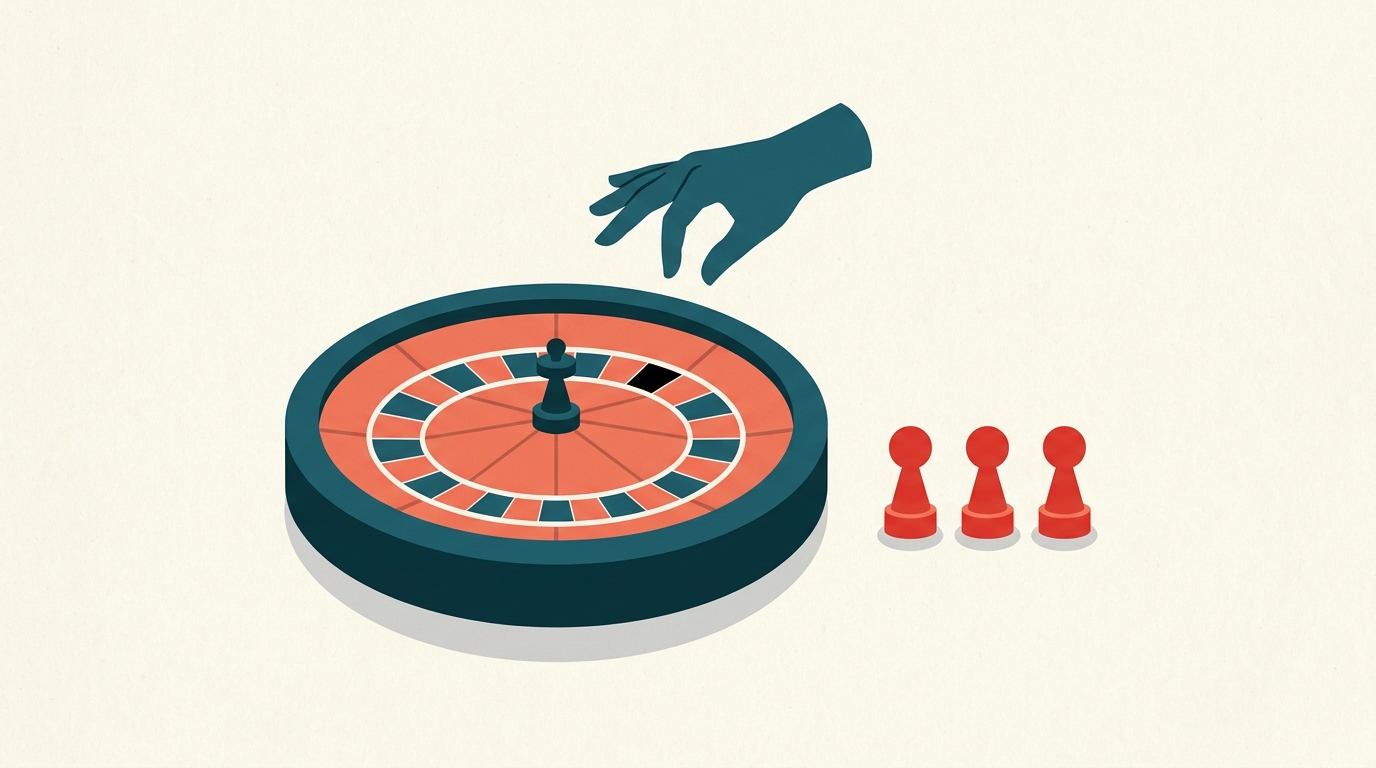
After a run of reds on a roulette wheel, black feels due — the belief that a random process must correct a recent streak is the gambler's fallacy. For , that correction never comes. The next spin of a fair roulette wheel is governed by the pockets on the wheel, not by the history board. A streak can be surprising, memorable, and emotionally persuasive, but it does not create a debt that the next result has to repay.
What the Numbers Show
48.6%
After 3 reds
48.6%
After 7 reds
48.6%
After 12 reds
On a European wheel the next spin is 18 red pockets out of 37 (about 48.6%), no matter how long the red streak ran.
Source: Roulette · Judgment under Uncertainty: Heuristics and Biases
Why intuition fails
The mind wants a small to look like the whole immediately, so it treats imbalance as something nature must fix. That is a misreading of the : in the long run, proportions tend to settle near their expected values, but that does not short runs must repair themselves. A streak is diluted by many later independent spins, not balanced by a special correction on the next spin.
Worked example
On a European roulette wheel, 18 of 37 pockets are red, 18 are black, and one is green zero. That makes the of red 18/37, about 48.6%, on any fair spin. If red has appeared ten times in a row, the next spin still has the same wheel and the same pockets. Black is not due. The long red streak was unlikely before it happened, but once it has happened it becomes part of the past — evidence that streaks happen, not a force the wheel must now compensate for.
How to use it
Ask whether the mechanism has memory. A roulette wheel, a coin toss, or a die roll is modeled as independent when the physical setup does not change from trial to trial. But not every process is independent. Cards drawn without replacement, fatigue in sports, changing weather, or a biased machine can make past observations relevant. The right question is not did a streak happen? but did the streak change the mechanism or reveal something about it?
What people get wrong
Draw cards from a deck without replacing them and earlier draws really do change later probabilities — no fallacy there. A fair, unchanged roulette wheel is the opposite: earlier spins change nothing. People misapply in both directions, expecting the memoryless wheel to correct its streaks while treating genuinely connected processes as if history did not matter. The gambler's fallacy is specifically the false correction story for independent trials.
When it applies
The gambler's fallacy applies to independent trials: roulette spins, fair coin flips, dice rolls, and other situations where the physical setup resets. Past results can matter when the process does not reset, such as drawing cards without replacement, machine wear, changing weather, or a player learning. The first question is whether the trials are truly independent.
Source note
The heuristics-and-biases work of Tversky and Kahneman explains why people expect small samples to look more balanced than random sequences really are. That supports the page's distinction between and the feeling that should self-correct.
Try It
Spin the wheel
Bet the colour that feels “due” and watch what the streak is really worth.
—
Place a bet and spin to start a streak.
—
“due” colour won
—
longest streak
—
total spins
Red
Black
After a long run of one colour, the other feels overdue — but the wheel has no memory. Over many spins the “due” colour wins about 48.6% of the time, exactly its baseline. The streak never moved the odds.
FAQ
Is black due after many reds?
No, not on a fair independent wheel. A European wheel still has 18 red pockets, 18 black pockets, and one zero on the next spin. The previous reds do not move the pockets or change the probability.
What about long-run balance?
Long-run balance appears because many independent future trials dilute earlier streaks. It does not appear because the next trial is forced to compensate. The next spin keeps the same probability.
When can past results matter?
Past results matter when the trials are not independent or when they reveal a biased mechanism. Drawing cards without replacement changes the deck. A streak from a fair roulette wheel does not change the wheel.
Quick Check
A fair European roulette wheel just landed on red ten times. What is the chance the next spin is red?
A
Higher — red is on a hot streak
B
About 48.6% — the same as every spin
C
Much lower — black is overdue
D
Exactly 50%
Sources
Gambler's fallacy
Secondary explainer
Wikipedia · Accessed 2026-06-14
Judgment under Uncertainty: Heuristics and Biases
Primary source
Science · Accessed 2026-06-14
Roulette
Secondary explainer
Wikipedia · Accessed 2026-06-14
Know someone who'd like this?
Read next

23 people are enough for a birthday match
A room with only 23 people is already more likely than not to contain two people with the same birthday.