Fact
23 people are enough for a birthday match
A room with only 23 people is already more likely than not to contain two people with the same birthday.
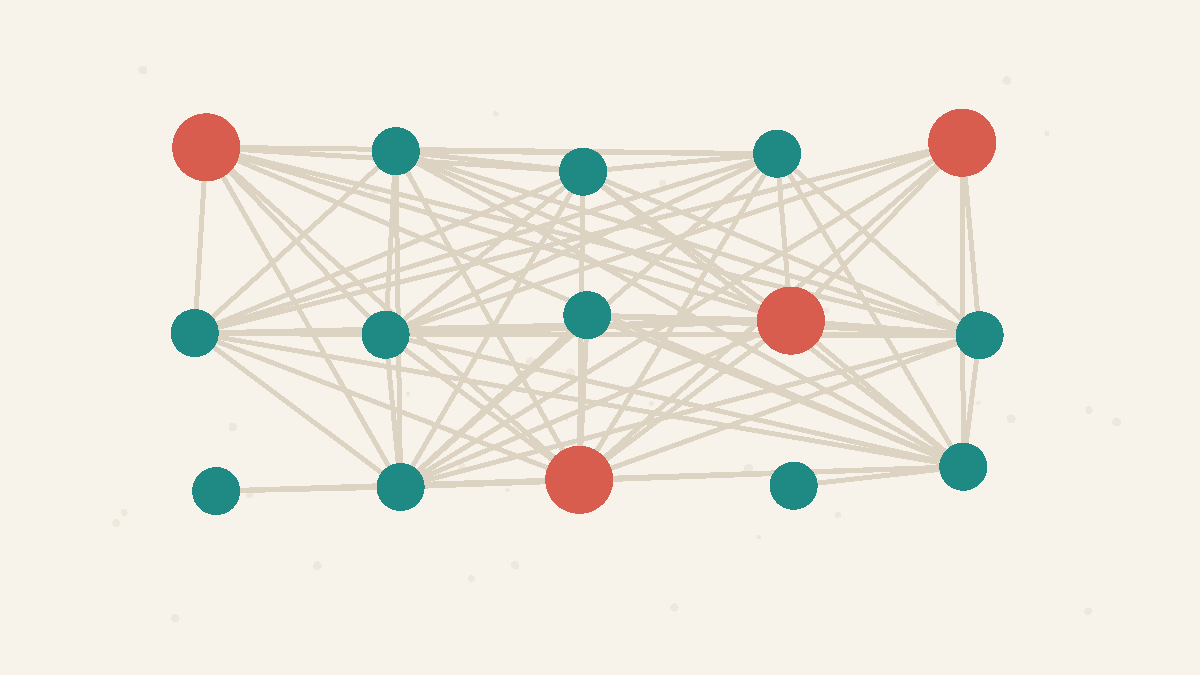
The trick is that every person can match with every other person, creating 253 possible pairs.
By the Math Says Yes editorial team
Human-reviewed under our source and correction standards.
How we review content
THE TRAP
People often compare one person against the calendar. The real question compares every person against every other person.
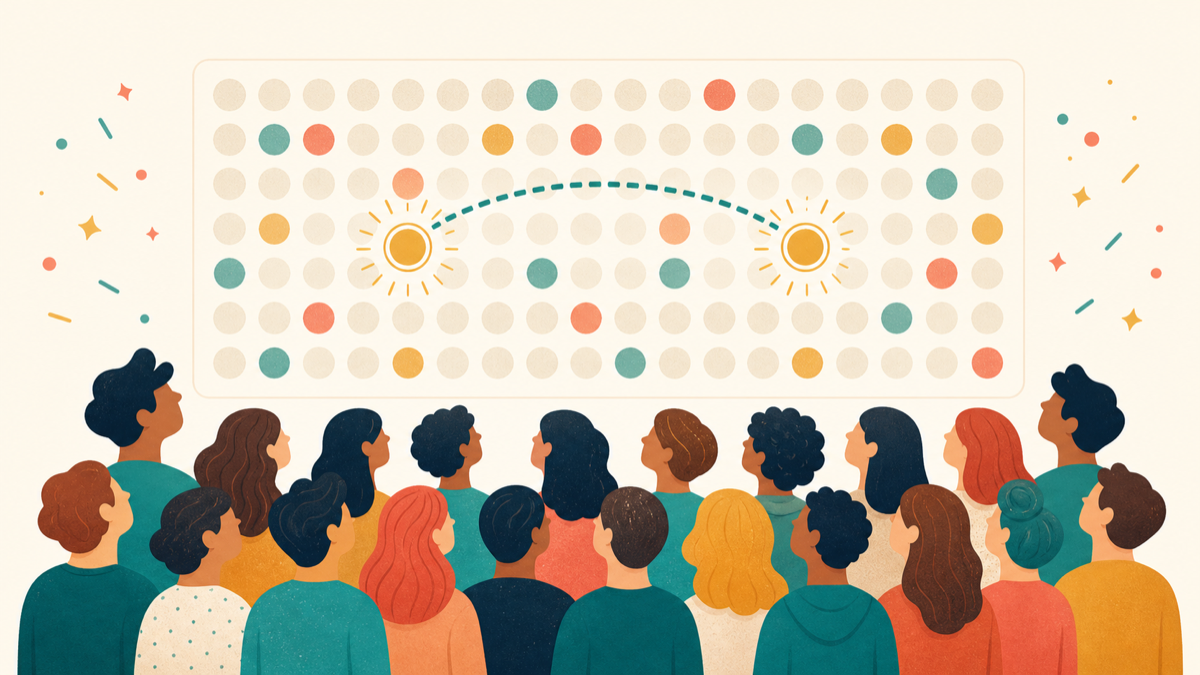
A visual reminder that matches grow through pairs, not one person versus the calendar.
AI-generated illustration
What this shows
Put 23 people in a room and you are not making 23 separate comparisons against the calendar; you are creating 253 possible person-to-person pairs. Any one of those pairs can produce the match. That is the central lesson: when every item can connect to every other item, the number of chances grows much faster than the group itself feels.
Why intuition fails
The result feels wrong because our attention locks onto one named person. If the question were "does someone match my birthday?", 23 people would not sound impressive. But the actual question gives every pair a . The 24th person would not add one more comparison; that person would compare against 23 people already in the room. Collision problems are relationship problems, and relationships multiply quietly in the background.
Worked example
With 23 people there are 23 x 22 / 2 = 253 different pairs, and any one of them can produce the match. The cleanest way to compute the is to ask the opposite question: how likely is it that nobody shares a birthday? The first person can have any birthday. The second must avoid that day, the third must avoid two, and each new arrival must avoid every birthday already taken, so the no-match path narrows with every person. Multiply those shrinking chances together and by 23 people the no-match probability has fallen below 50% — which means at least one shared birthday is more likely than not.
How to use it
Use this whenever a coincidence appears in a group: shared birthdays, matching names, repeated search results, duplicate choices, or two people making the same mistake. Before deciding that the event is extraordinary, count the hidden opportunities for it to happen. Ask what counts as a pair, how many pairs were available, and whether you noticed the coincidence only after scanning many possible matches.
What people get wrong
The classic misstep is holding 23 people up against 365 days and concluding the room is far too small. That comparison answers a different question — whether someone matches one fixed birthday, such as yours. The paradox asks the wider question: will any two people match each other? Reason from the narrow version and the answer feels impossible; count the pairs and it stops being mysterious.
When it applies
The birthday pattern appears whenever many pairwise comparisons are made: duplicate IDs, hash collisions, repeated passwords, matching records, or coincidental similarities in a large group. The exact threshold changes when outcomes are not equally likely or independent, but the lesson survives: many small collision chances can become a large total .
Source note
Wolfram MathWorld is used as the authoritative math reference for the birthday problem formula and threshold. The page's explanation turns that formal calculation into the practical intuition: count pairs, not only people.
Try It
Birthday room
Add one person and watch their new comparisons fan out.
With 23 people in a room, how many different pairs are possible?
Choose an answer, then build the room and watch the pairs multiply.
FAQ
What is the main statistical idea?
The main idea is pairwise comparison. A group does not create one chance per person; it creates one chance per pair of people. With 23 people, that is already 253 possible pairs, so a match can arrive through many routes.
Why is the opposite question useful?
It is easier to compute the chance that no birthdays match, because each new person simply has to avoid the birthdays already present. Once that no-match chance drops below 50%, the chance of at least one match must be above 50%.
Where else does this pattern appear?
The same pattern appears whenever many items can collide with one another: duplicate names, repeated passwords, matching records, or surprising coincidences in a large group. The first move is always to count opportunities, not only outcomes.
Quick Check
Why does the birthday paradox become likely with only 23 people?
A
Because 23 is close to 365 divided by 12.
B
Because there are 253 possible pairs to compare.
C
Because birthdays are mostly in one month.
Sources
Birthday Problem
Authoritative source
Wolfram MathWorld · Accessed 2026-06-20
Birthday problem
Secondary explainer
Encyclopedic reference · Accessed 2026-06-13
Know someone who'd like this?
Read next
A roulette wheel has no memory
After red lands ten times in a row, black feels 'due'. The next spin is still about 48.6% red, exactly as it was on the first.