Fact
One grain of rice can bankrupt an empire
Place one grain on a chessboard's first square and double it each square — the last square alone reaches 2⁶³ grains.
After 63 doublings, the last square holds about 9.22 quintillion grains; the whole board exceeds 18.4 quintillion.
By the Math Says Yes editorial team
Human-reviewed under our source and correction standards.
How we review content
THE TRAP
The first few squares look trivial, so we assume the whole board is manageable — but doubling never slows down.
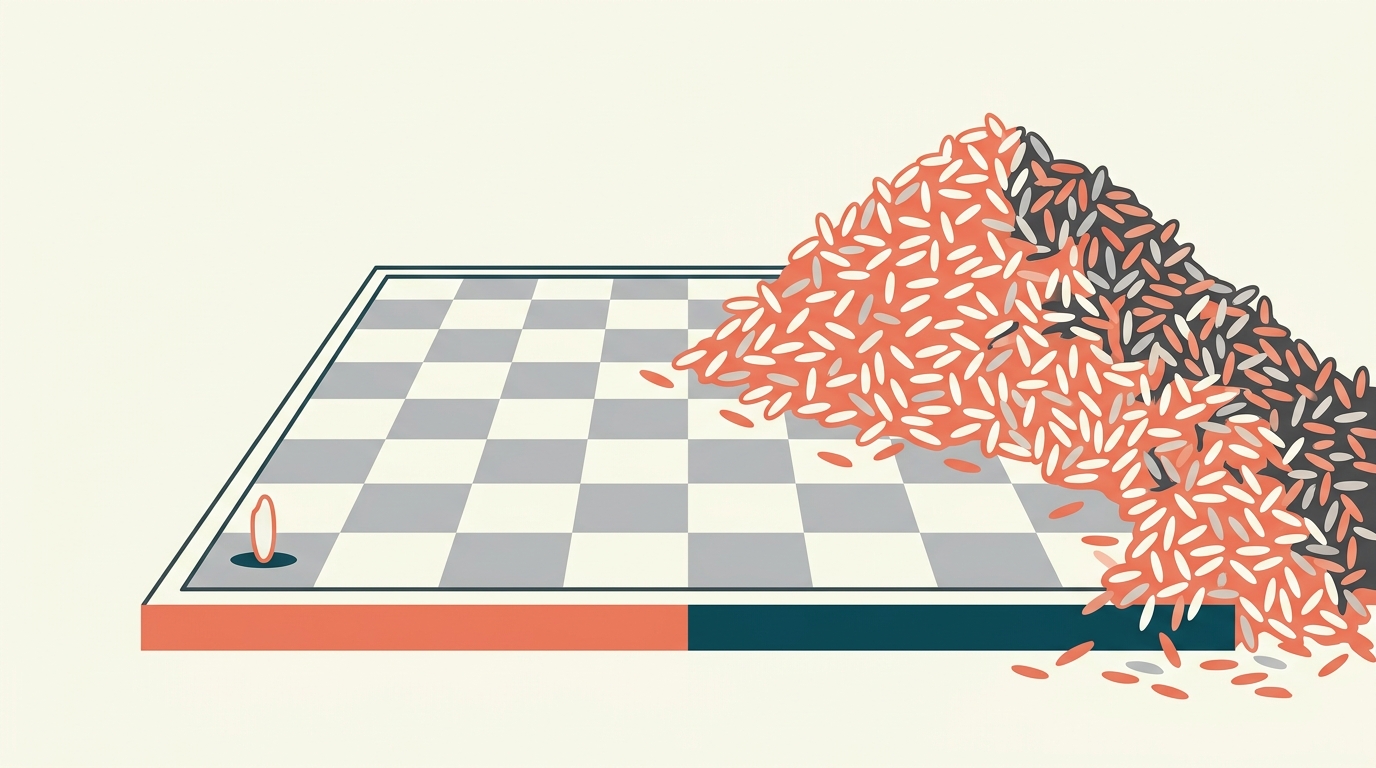
What this shows
The first square holds 1 grain, the second 2, the third 4, and square n holds 2^(n-1) grains — a clean geometric sequence. That formula is the whole trap. The early squares look harmless because the numbers are small, but the exponent keeps rising. By the 64th square, one tiny starting grain has become a number no everyday intuition can picture.
What the Numbers Show
1
1
2
2
4
3
8
4
16
5
32
6
64
7
128
8
Grains per square for the first 8 squares — already 128. By square 64 the total tops 18 quintillion grains.
Source: Wheat and chessboard problem · Geometric Series
Why intuition fails
The first half of the board misleads because it still feels countable. But in a doubling sequence, every new square contains one more grain than all previous squares combined. That means the final square is roughly half of the entire board's total. Intuition treats 64 steps as not very many. Exponential growth treats 64 doublings as a gigantic multiplier: 2 multiplied by itself 63 times after the first grain.
Worked example
The first eight squares contain 1, 2, 4, 8, 16, 32, 64, and 128 grains on the individual squares. Together, those first eight squares total only 255 grains. The 32nd square alone is already over 2.1 billion grains. The 64th square alone is over 9.22 quintillion grains, and the whole board totals 2^64 - 1, about 18.45 quintillion grains. The traditional story often uses wheat; using rice changes the object, not the mathematics.
How to use it
For any repeated doubling process, inspect the exponent and the last few terms. Do not the early and late steps in your head. Ask what term n equals, how many doublings have occurred, and how much of the total sits near the end. This applies to populations, viral spread, storage needs, and any process where each step multiplies the previous one.
What people get wrong
Square eight holds only 128 grains, and from there the whole board still feels manageable. Judging the process by its visible beginning works for linear growth, where each step adds the same amount; in a doubling series the early squares are the warm-up, not a preview. A second mistake is confusing the final square with the total: the last square alone holds about 9.22 quintillion grains, while the whole board totals about 18.45 quintillion. Both numbers are huge, but they answer different questions.
When it applies
The chessboard story is useful for compound interest, viral spread, storage growth, repeated halving, and any process where change is proportional to the current size. It is not a claim that every fast-growing process can continue forever. Real systems hit limits, but the early phase can still surprise people who think linearly.
Source note
The rice total is a geometric sum, so the formal backing is Wolfram MathWorld's geometric-series reference. The page uses the chessboard story as an accessible version of that formula: repeated multiplication changes scale much faster than repeated addition.
Try It
Rice on a chessboard
Move through the 64 squares and watch grains explode.
Square
square 1 of 64
Squares 1–5 show real grains — after that there are too many to draw.
1
grains on this square
1
total so far
By square 1, this square alone holds 1 grains and the board totals 1. Each square doubles the one before — trivial at the start, unimaginable by square 64.
FAQ
How many grains are on the whole board?
The total is 2^64 - 1 grains, about 18.45 quintillion. The last square alone has 2^63 grains, about 9.22 quintillion, so it accounts for roughly half the total.
Why do the last squares matter so much?
In a doubling sequence, each new square is larger than the sum of all previous squares. That makes the ending dominate the total. The early squares are mathematically real, but they do not show the eventual scale.
What is the practical lesson?
When a process doubles repeatedly, count the doublings and inspect the final terms. Early behavior can look harmless even when the later values are already locked into the formula.
Quick Check
With 1 grain on the first square and doubling after each square, the total across all 64 squares is:
A
About 18.45 quintillion grains
B
About 9.22 quintillion grains
C
2⁶⁴ grains on every square
D
Roughly 64 grains
Sources
Geometric Series
Authoritative source
Wolfram MathWorld · Accessed 2026-06-20
Wheat and chessboard problem
Secondary explainer
Wikipedia · Accessed 2026-06-14
Know someone who'd like this?
Read next

Money doubles slowly, then all at once
Divide 72 by the yearly growth rate and you get the years it takes to double — a trick that hides a steep curve.