Fact
Money doubles slowly, then all at once
Divide 72 by the yearly growth rate and you get the years it takes to double — a trick that hides a steep curve.
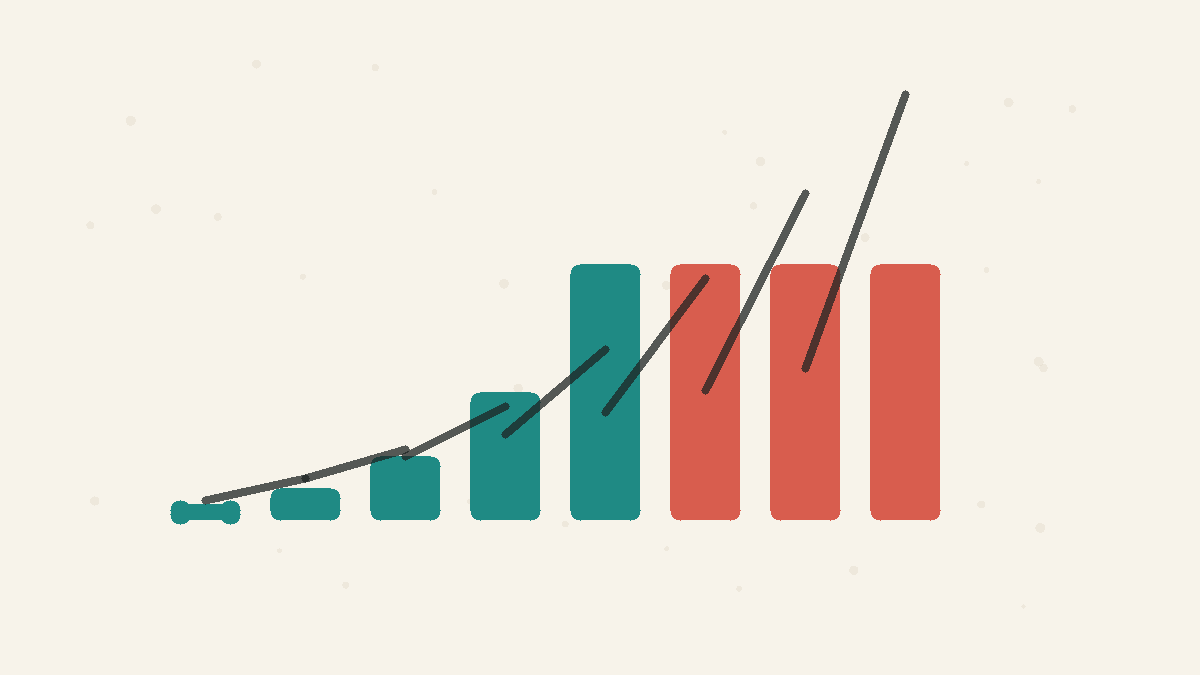
Steady percentage growth looks flat for years, then climbs sharply as each step adds more than the last.
By the Math Says Yes editorial team
Human-reviewed under our source and correction standards.
How we review content
THE TRAP
We picture growth as a straight line, so we expect the same gain each year — but a percentage compounds on a bigger base every time.
What this shows
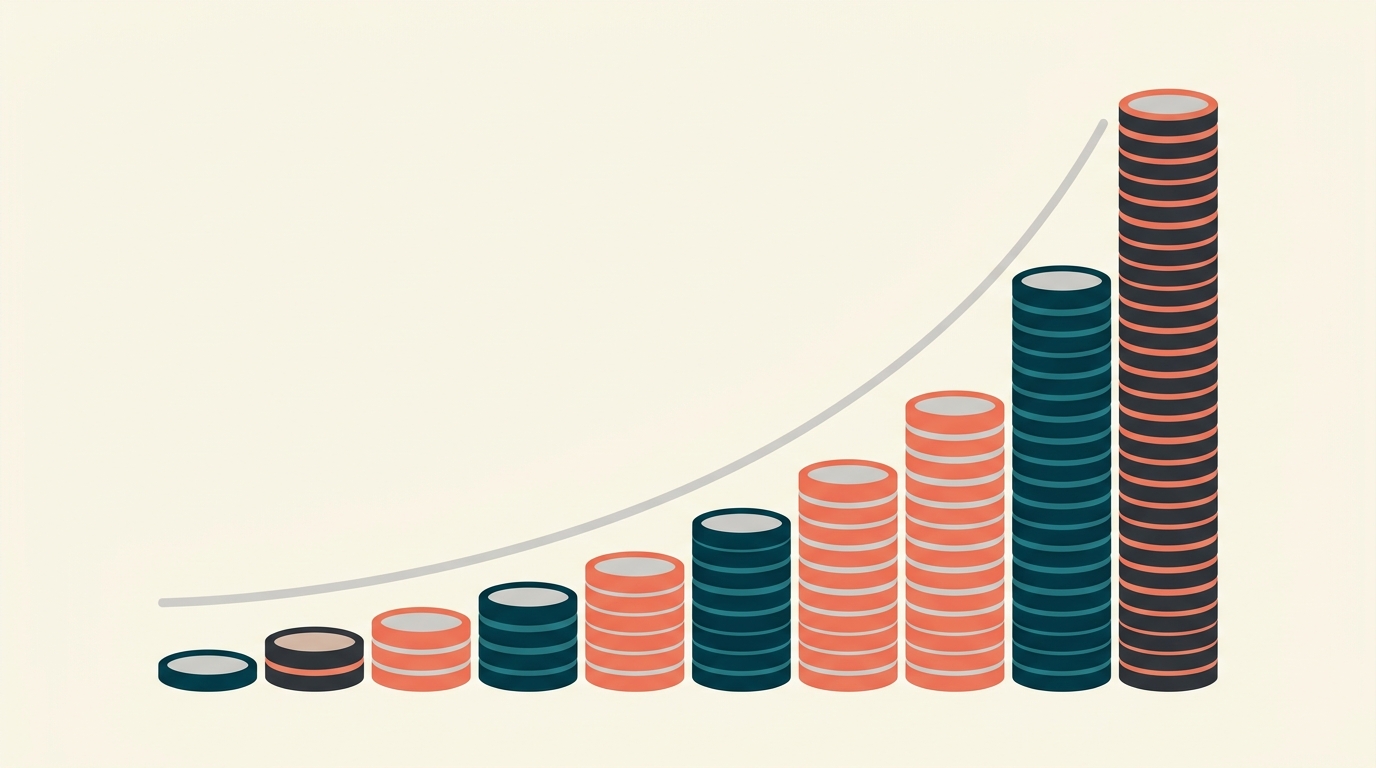
The rule of 72 is a mental shortcut for compound growth. Divide 72 by a yearly percentage rate to estimate how many years one doubling takes. At 6% growth, 72 divided by 6 gives about 12 years. The shortcut works because constant percentage growth multiplies the base. The same percent is applied to a larger amount each period, so later years add more than earlier years.
What the Numbers Show
0
6
12
18
24
30
36
$1,000 growing at 6% a year
years →
At 6% a year, money doubles about every 12 years (72 ÷ 6) — nearly flat at first, then steep.
Source: Rule of 72 · The rule of 69
Why intuition fails
Linear intuition expects the same absolute gain each year. Compound growth does not behave that way. A fixed percentage is small when the base is small and large when the base is large. The early part of the curve feels slow because the base has not had time to grow. The later part feels sudden because each percentage gain is now applied to all the earlier gains too.
Worked example
Start with 1,000 growing at 6% per year: the rule says 72 / 6, about 12 years per doubling. After roughly 12 years it is near 2,000, after 24 near 4,000, after 36 near 8,000. Each 12-year block is one doubling, but the dollar gain is not the same: the first doubling adds about 1,000, the next adds about 2,000, and the next adds about 4,000. That is why the line looks quiet early and steep later. At 9% the same shortcut gives about 8 years. The exact math behind doubling time gives 69.3, but 72 stuck because it is close and divides cleanly by 2, 3, 4, 6, 8, 9, and 12.
How to use it
Use the rule as a quick sense-check, not a promise. It works for steady compound rates: growth, inflation, debt, fees, or anything that compounds by a percentage. Divide 72 by the rate to estimate doubling time, or divide 72 by the years to estimate the rate needed to double. For real investments, taxes, fees, volatility, and changing rates can make the path very different.
What people get wrong
"72 divided by 6" is not a forecast that your money will double in 12 years. The rule assumes a steady rate, and most real rates are not steady: a stock return, a business growth rate, or short-run inflation swings around instead of compounding smoothly, while fees quietly change the effective rate — and debt compounds against you. The shortcut answers one narrow question: if a rate stayed roughly constant and compounded, about how long would one doubling take? Whether the rate stays anything like constant is a separate question it cannot answer.
When it applies
Use the Rule of 72 for quick estimates of doubling time in savings, prices, populations, traffic, debt, or inflation (where doubled prices each unit of money buys half as much). It is best for moderate positive rates and regular compounding. It is less reliable for very high rates, volatile rates, one-time jumps, or situations where contributions and withdrawals dominate the growth rate.
Source note
Gould and Weil's paper covers the related Rule of 69 and the mathematical approximation behind doubling-time shortcuts. This page uses the more familiar Rule of 72 as a practical mental model for compound growth.
Try It
Doubling time
Change the starting amount, yearly growth rate, and comparison rate.
Invested amount
$
Time horizon
30 years
Growth rate
6% a year
$57,435
after 30 years
Compare with
2% a year
$18,114
after 30 years
12 yr
years to double at 6%
+$39,321
extra after 30 years vs 2%
30-year path
$0
$15,000
$30,000
$45,000
$60,000
$57,435
$18,114
0
6
12
18
24
30
Divide 72 by the rate to get the doubling time. The teal line uses your selected rate; the coral line uses 2% a year. After 30 years, the selected path is +$39,321 versus the comparison.
FAQ
What is the rule of 72?
It is a shortcut for estimating doubling time under compound growth. Divide 72 by the yearly percentage rate. At 6% per year, 72 divided by 6 gives about 12 years to double.
Why does compounding feel slow at first?
Because the same percentage is applied to a small base early on. Later, the base includes all previous growth, so the same percentage creates much larger absolute gains.
When should I not trust the shortcut?
Do not treat it as a forecast when the rate is volatile, temporary, fee-heavy, or uncertain. It is a mental model for constant compound growth, not a guarantee that a real-world return will continue.
Quick Check
At 6% growth a year, roughly how long until money doubles?
A
About 12 years
B
About 50 years
C
About 6 years
D
About 100 years
Sources
Rule of 72
Secondary explainer
Wikipedia · Accessed 2026-06-14
The rule of 69
Primary source
The Journal of Business · Accessed 2026-06-20
Know someone who'd like this?
Read next
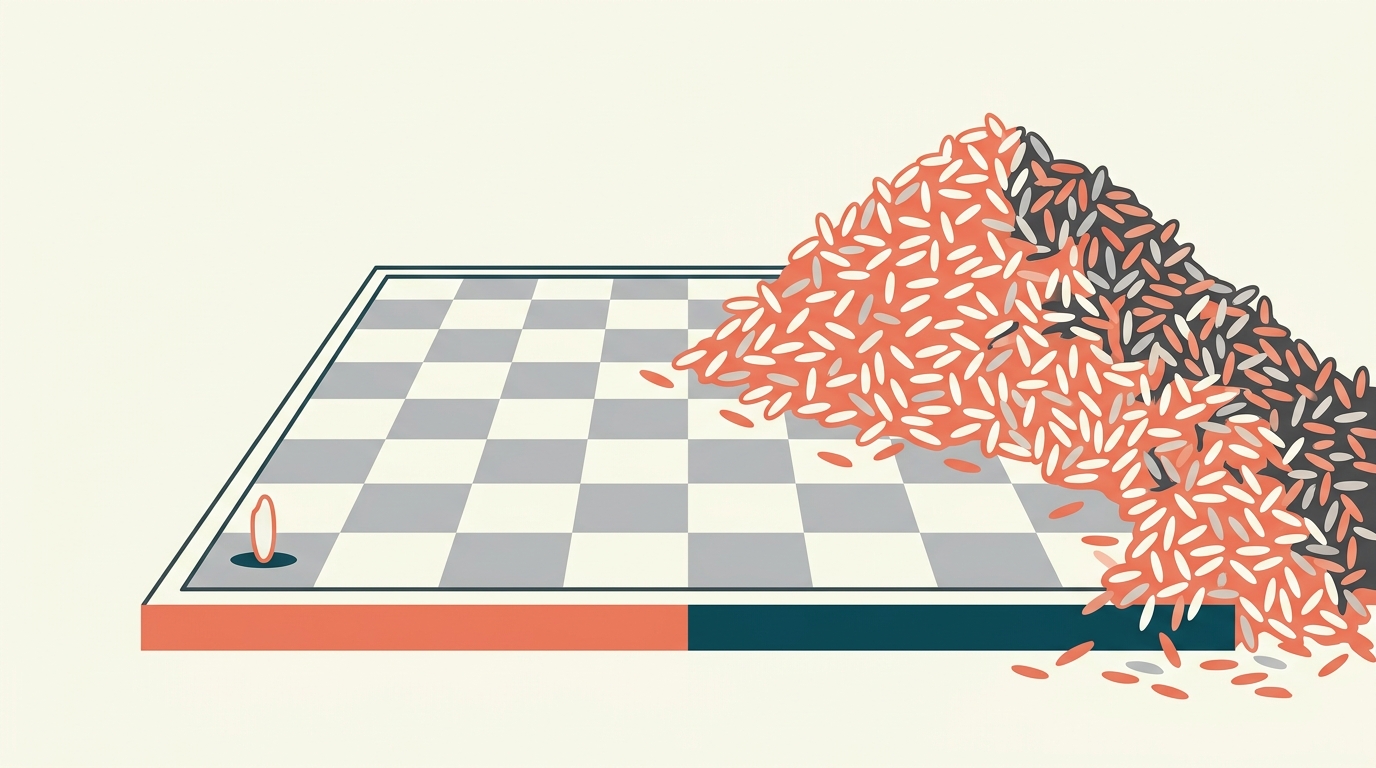
One grain of rice can bankrupt an empire
Place one grain on a chessboard's first square and double it each square — the last square alone reaches 2⁶³ grains.