Lesson
Independent Errors Cancel
Average many independent guesses and their random errors offset, leaving an estimate closer to the truth than most individuals.
By the Math Says Yes editorial team
Human-reviewed under our source and correction standards.
How we review content
Signal plus noise
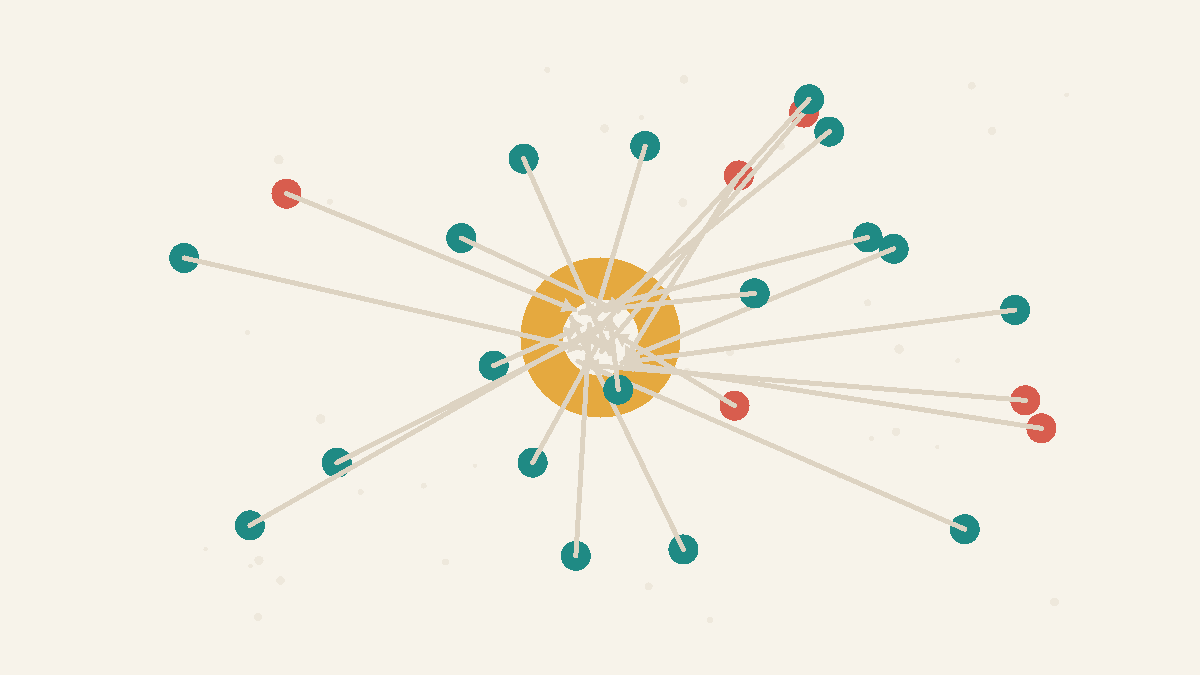
Treat every estimate as two parts added together: the true value, which everyone is aiming at, and a personal error that misses it by some amount in some direction. The error comes from gaps in knowledge, a hasty look, a , or pure guesswork. One person's error might run high, another's low, and a third might land close by luck. Because the true value is the same for everyone, it is the steady part of every guess. The error is the part that wobbles from person to person, and it is exactly the part that averaging can attack.
Why averaging helps
When you many guesses, the shared true value stays put because it appears in every one. The errors, however, point in different directions, so the ones that overshoot partly cancel the ones that fall short. With more independent, roughly uncorrelated estimates, the leftover error in the average keeps shrinking, while the true signal does not move. That is why the crowd average can beat almost every single person: no individual gets to cancel their own error, but the group cancels each other's. The improvement is not magic, it is arithmetic working on opposing mistakes.
The independence condition
The cancellation only works while the errors are independent of each other. If everyone draws on the same rumour, the same flawed source, or simply hears the loudest voice in the room and copies it, their errors stop pointing in random directions and start lining up. Aligned errors do not cancel; they add up, so the inherits the shared mistake instead of washing it out. is the enemy of the crowd. The more people influence each other before guessing, the more the average behaves like one opinion repeated many times rather than many opinions combined.
Using it
To get the benefit in practice, gather the estimates privately before anyone shares them, then . Ask each person, team, or model for a number on its own, without seeing the others, so their errors stay independent. Only after the guesses are locked in should you combine them and discuss. This is why good forecasting groups collect silent estimates first and why repeating a careful measurement and averaging the readings beats trusting a single shot. Protect first, then let the average do the cancelling.
FAQ
Why does averaging many guesses reduce error?
Each guess carries a random error that points high or low. When the guesses are independent, the high and low errors partly offset as you average, so the average ends up closer to the true value than most single guesses.
When does averaging estimates stop helping?
It stops helping when the errors are no longer independent. If people copy each other or share the same flawed source, their errors line up instead of cancelling, so the average keeps the common mistake rather than washing it away.
Try the idea
Find the crowd's middle guess
Each dot is one private guess. Coral marks the middle; teal marks the ox's real weight.
750 lb
1,650 lb
private guess
middle guess
real weight · 1,198 lb
1188 lb
middle guess
10 lb
middle misses by
10 private guesses
one person misses by, on average: 224 lb
Some guesses are too high and others too low. With 10 private guesses, the middle is 10 lb from the ox.
Illustrative guesses, not Galton's original data.
Quick Check
Why did the crowd's middle guess land so close to the ox's real weight?
A
Private guesses missed both high and low.
B
Everyone copied the most confident guesser.
C
Most people already knew the exact weight.