Lesson
Random Looks Streaky
Real randomness clumps; an even, tidy spread is the surprise.
By the Math Says Yes editorial team
Human-reviewed under our source and correction standards.
How we review content
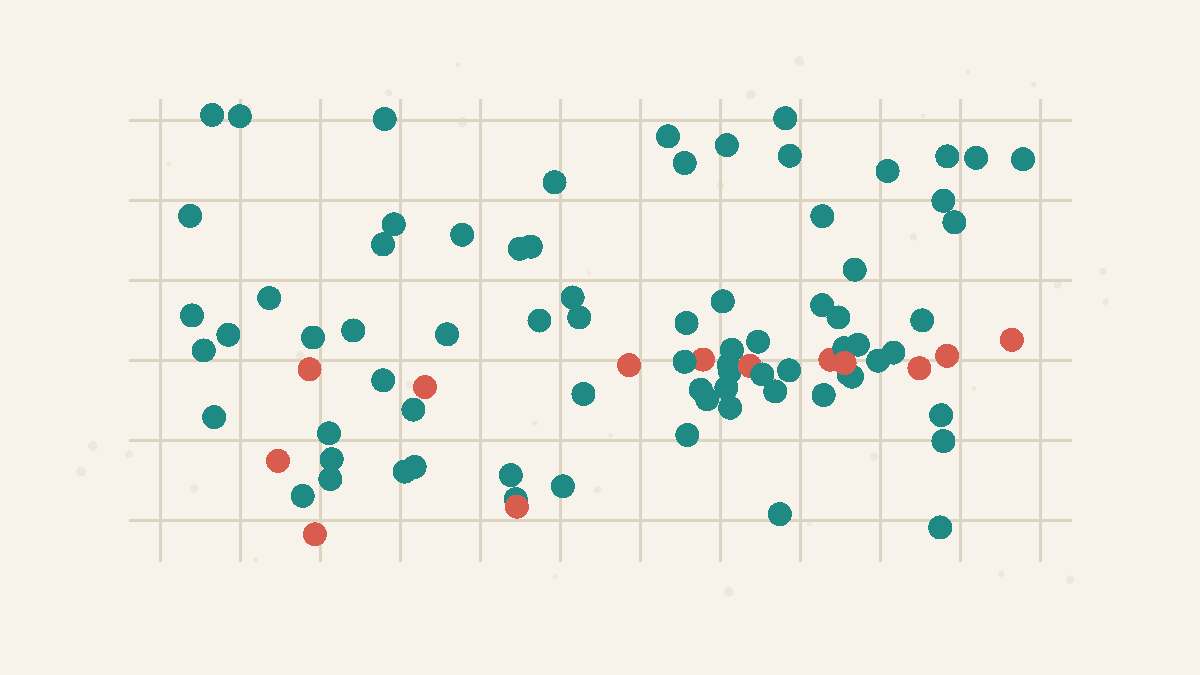
Random does not mean evenly spaced
People often imagine randomness as a neat mix with no obvious clumps. Real randomness is messier. If events are placed independently, nothing prevents several from landing close together and nothing forces empty areas to be filled. Clusters and gaps are therefore normal, not suspicious by default. An overly even pattern can actually be less random than a pattern with awkward-looking streaks and bunches.
The clustering illusion
The clustering illusion happens when we see meaning in ordinary random clumps. A few cancer cases in one neighborhood, several wins in a row, or repeated similar songs can feel like a hidden cause. Sometimes there is one. Often the pattern is what random placement naturally creates when enough opportunities exist. The danger is that the human eye is excellent at finding patterns and poor at judging how often produces them.
Compare the cluster to a chance model
Before treating a cluster as evidence, ask what a random process would normally produce. Simulations, shuffle tests, or simple calculations can show whether the observed streak is unusual. The right comparison is not a perfectly even pattern. It is many random patterns produced under the same rules. If similar clusters appear often in those simulations, the observed cluster is weaker evidence than it first feels.
Investigate without overreacting
A cluster can be a clue worth checking, especially when the cost of missing a real cause is high. The mistake is jumping from cluster to explanation without comparing it to . A practical response is staged: verify the data, define the area or time window before looking again, compare with a random baseline, then search for mechanisms. This keeps curiosity alive while preventing every streak from becoming a false story.
FAQ
Are streaks evidence that something is not random?
Not by themselves. Random processes naturally create streaks and gaps, so you need to compare the observed streak with what chance would often produce.
Why do people expect randomness to look balanced?
We confuse randomness with deliberate mixing. Independent random events are not spaced out by a planner, so clumps appear more often than intuition expects.
Try the idea
Random scatter
Drop 100 points into 100 cells and see where they land.
—
empty cells
—
busiest cell
Purely random drops clump naturally. Around 37 cells stay empty every time — clustering is what randomness looks like.
Quick Check
If you scatter points completely at random across a grid, the result usually looks…
A
Arranged in a neat grid
B
Perfectly even and regularly spaced
C
Clumpy, with clusters and empty gaps
D
Bunched into a single corner