Fact
A random number can drag your guess
Spin a wheel to a random number, then ask people to estimate a fact — and those who saw a bigger number guess bigger, even when the number was obviously meaningless.
An arbitrary starting point pulls estimates toward it because we adjust away from it too little. The anchor sets the answer without anyone deciding it should.
By the Math Says Yes editorial team
Human-reviewed under our source and correction standards.
How we review content
THE TRAP
We feel our estimates come from what we know, not from the last number we happened to see. But the irrelevant anchor quietly becomes the starting line, and we rarely travel far enough from it.
What this shows
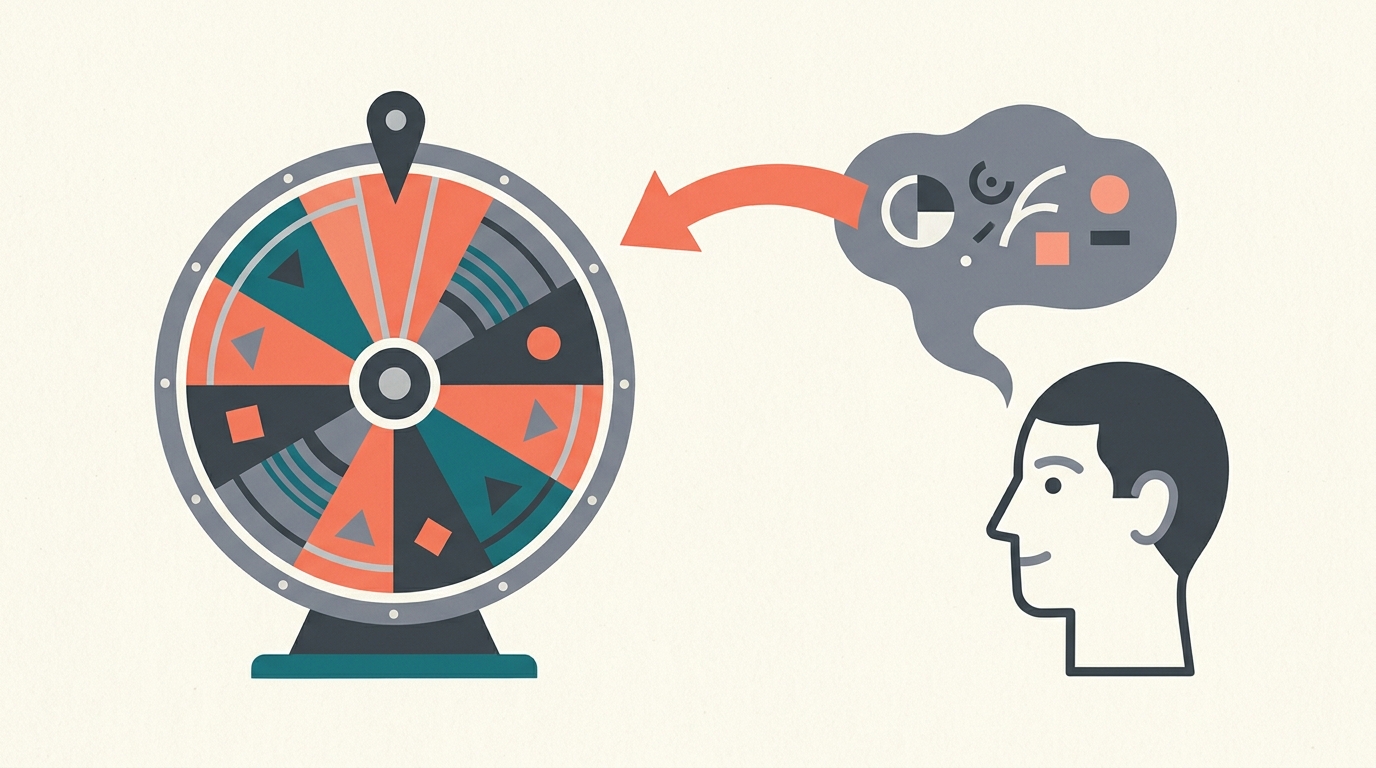
The first number you hear becomes the reference point for the judgment that follows — that pull is anchoring. The number can be useful, arbitrary, or obviously irrelevant, but it still pulls estimates toward itself. People often start from the anchor and adjust away from it, then stop too soon. The result is not random noise: high anchors tend to produce higher estimates, and low anchors tend to produce lower estimates.
What the Numbers Show
Wheel 10 → guess 25%
25%
Wheel 65 → guess 45%
45%
Everyone answered the same question. Only the irrelevant wheel number changed, yet the middle guesses moved by 20 percentage points.
Source: Anchoring (cognitive bias) · Judgment under Uncertainty: Heuristics and Biases
Why intuition fails
Asked for a number you do not know, the mind wants a starting line, so the available number gets used even if it should not matter. Anchors work best exactly when the true value is uncertain. Rejecting the anchor requires extra work: you have to ask whether it is relevant, search for another reference, and move far enough away. Most people do some adjustment, but not enough, so the anchor remains visible in the final answer.
Worked example
In the classic Tversky and Kahneman demonstration, participants spun a wheel that was rigged to stop at either 10 or 65. They were then asked whether the percentage of African countries in the United Nations was higher or lower than that number, and finally to estimate the true percentage. The low-anchor group gave a estimate of 25%. The high-anchor group gave a median estimate of 45%. The wheel was visibly random and irrelevant, yet the starting number changed the estimates by 20 percentage points.
How to use it
When a first number appears in a price, negotiation, forecast, salary range, or estimate, label it as an anchor before reacting. Then build a second estimate from independent evidence: base rates, comparable cases, historical data, or a private range written down before seeing the other side's number. In groups, ask people to estimate silently first so one early number does not steer everyone else.
What people get wrong
A list price, first offer, random comparison, suggested default, or previous estimate can shape judgment simply by becoming the starting point — an anchor does not have to be relevant or persuasive to matter. Two errors follow from missing that. One is treating the first number on the table as neutral information: it may be useful evidence, but it is also a psychological starting point, so it deserves a deliberate second reference. The other is believing awareness is enough — knowing a number is irrelevant can reduce its pull, but it does not automatically erase it.
When it applies
Anchoring is most relevant when estimates are uncertain and the first number is salient: negotiations, pricing, forecasts, planning, performance targets, and survey questions. It is weaker when people have strong independent knowledge or when the task has an objective calculation they actually perform. To reduce anchoring, generate an independent estimate before seeing suggestions and compare multiple reference points.
Source note
The anchoring-and-adjustment idea, along with the classic random-number demonstration, comes from Tversky and Kahneman's heuristics-and-biases paper. That supports the page's claim that even arbitrary starting values can pull estimates.
FAQ
What is the anchoring effect?
The anchoring effect is the tendency for an initial number to pull later judgments toward it. The anchor can be useful or arbitrary. The problem is that people often adjust away from it too little.
Why did the random wheel change estimates?
The wheel gave people a starting point before they estimated an uncertain quantity. Even though the number was random, participants adjusted from it and stopped too soon. That pulled the median guesses toward 10 or 65.
How can I reduce anchoring?
Make an independent estimate before looking at someone else's number. Use base rates, comparable cases, or historical data. If an anchor is already visible, deliberately generate a second reference and consider why the anchor could be wrong.
Quick Check
People shown a high random number before estimating a quantity tend to give answers that are…
A
Completely random
B
Unchanged — they ignore it
C
Lower, to compensate
D
Higher, pulled toward the number
Sources
Anchoring (cognitive bias)
Secondary explainer
Wikipedia · Accessed 2026-06-14
Judgment under Uncertainty: Heuristics and Biases
Primary source
Science · Accessed 2026-06-14
Know someone who'd like this?
Read next
Randomness clumps more than you think
Scatter 100 raindrops across 100 tiles at random and about 37 tiles stay completely dry — while others catch two or three. Real randomness clusters.