Fact
The door you did not pick is probably better
In Monty Hall, switching doors wins about twice as often as staying.
The host's action is not random noise. It gives you information about where the prize is not.
By the Math Says Yes editorial team
Human-reviewed under our source and correction standards.
How we review content
THE TRAP
After one losing door is opened, it feels like two doors remain with equal odds. They do not.
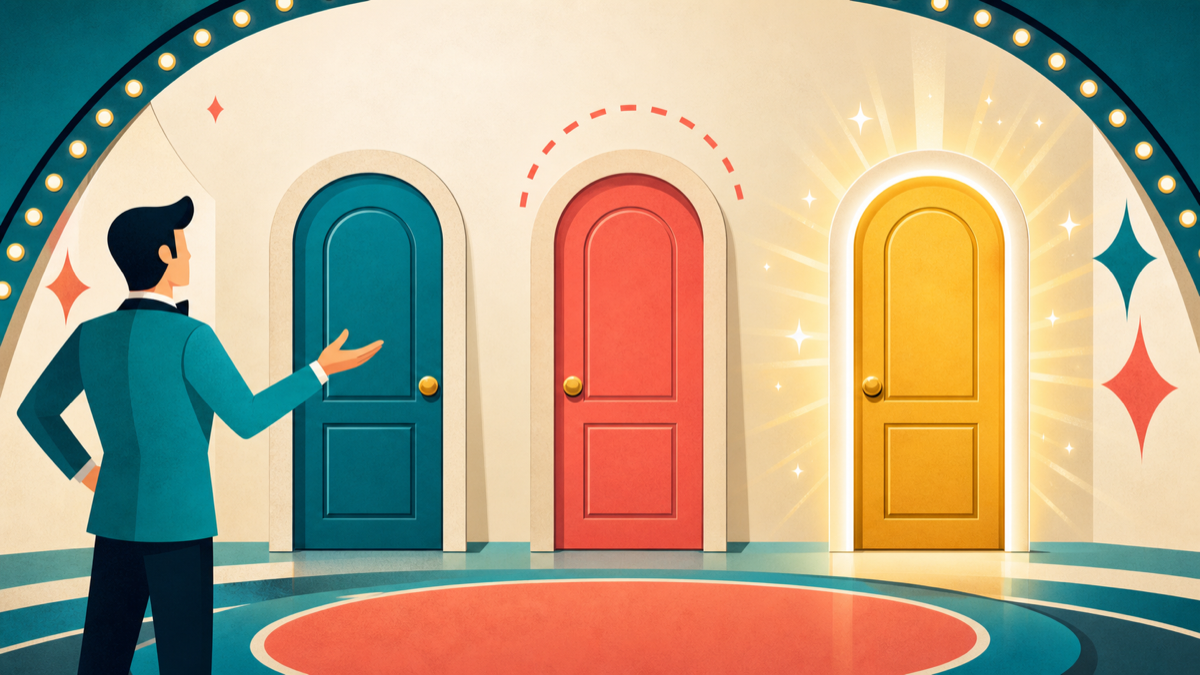
The opened door changes what the remaining closed door means.
AI-generated illustration
What this shows
Monty Hall shows that information is not just about what you see; it is also about how that information was produced. The host does not open a random door. He opens a losing door while knowing where the prize is. That rule changes the meaning of the remaining closed door. Conditional is the broader idea: once new information rules out some cases, you should compare the cases still compatible with what happened.
Why intuition fails
The intuition fails because the visible scene looks symmetric: two closed doors, one prize. But the history of the scene is not symmetric. One door is the door you picked before any information arrived. The other survived a host action that was constrained by the prize location. Treating those doors as identical throws away the process that created them. In problems, the path to the current state often matters as much as the current state itself.
Worked example
At the start, your chosen door has a 1 in 3 of hiding the car, and the two doors you did not choose together carry the remaining 2 in 3 chance. The host then opens a goat door from that unchosen side. Because he was forced to avoid the car, the probability does not split evenly across the two closed doors: your original door keeps its 1 in 3 chance, and the remaining unchosen door carries the full 2 in 3. Switching wins whenever your first pick was wrong — which happens 2 times in 3.
How to use it
Use this pattern whenever someone filters, reveals, ranks, or removes options for you. Ask what rule they followed and what they knew when they acted. A search result, recommendation, diagnosis, or edited comparison can change the space in the same way. Do not just count the visible options after the reveal; count the possible worlds that could have produced that reveal.
What people get wrong
The classic error is resetting the game after the host opens a door — treating the two remaining closed doors as a fresh 50/50 draw. That reset would be valid only if the host's reveal were random in the right way, and in the classic setup it is not: he always reveals a losing door and always offers the switch. The opened door tells you something about the unchosen side; it does not erase your original 1 in 3 .
When it applies
Switching is better only under the standard host rules: the host knows where the car is, always opens a goat door, always offers the switch, and never opens your chosen door. If the host opens doors randomly, sometimes refuses to offer a switch, or behaves differently when you first picked the car, the probabilities change. The rule is about information, not doors.
Source note
The primary statistics source is the American Statistician paper by Morgan and coauthors, which analyzes the player's dilemma and the role of the host's protocol. That is the key nuance: the answer depends on the rules that generated the host's information.
Try It
Play Monty Hall
Three doors, one prize. Beat the host if you can.
You pick a door, then the host opens a losing one. Will switching doors help you?
Pick a door — one of the three hides the prize.
FAQ
What is the main statistical idea?
The main idea is conditional probability. The host's reveal is information produced by a rule, not a neutral event. Once you condition on that rule, the remaining unchosen door is no longer equivalent to your first pick.
Why is switching better?
Your first choice starts with a 1 in 3 chance. The two unchosen doors start with a combined 2 in 3 chance. When the host removes a losing door from the unchosen side, the remaining unchosen door keeps that larger chance.
When would it be a fifty-fifty choice?
It would be fifty-fifty in a different setup where the remaining closed doors were produced symmetrically. In the classic Monty Hall setup, the host deliberately opens a losing door, so the two closed doors have different histories and different odds.
Quick Check
In the classic Monty Hall problem, what should you do after the host opens a losing door?
A
It does not matter.
B
Switch doors.
C
Stay with your first choice.
Sources
Let's make a deal: The player's dilemma
Primary source
The American Statistician · Accessed 2026-06-20
Monty Hall problem
Secondary explainer
Wikipedia · Accessed 2026-06-14
Know someone who'd like this?
Read next

A one-in-a-million match is not a one-in-a-million chance of innocence
When a forensic trait matches 1 in a million people, a big enough population still holds many innocent matches — the match probability is not the probability of innocence.