Fact
A one-in-a-million match is not a one-in-a-million chance of innocence
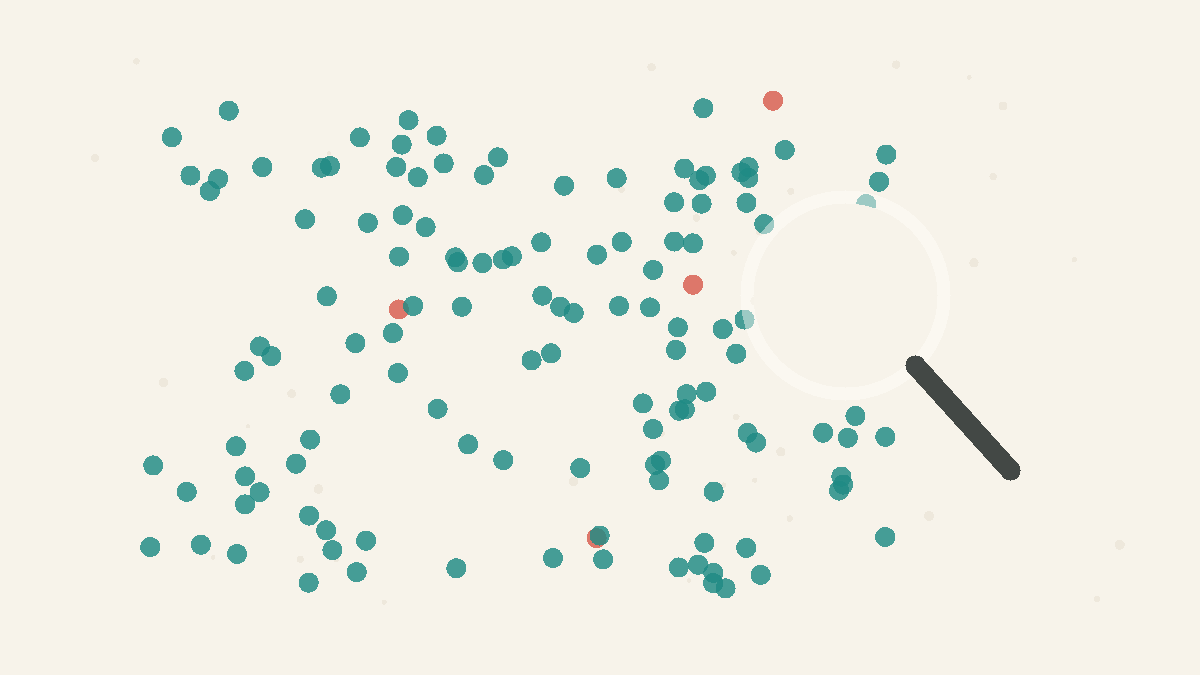
When a forensic trait matches 1 in a million people, a big enough population still holds many innocent matches — the match probability is not the probability of innocence.
Multiply the match rate by the population searched: a 1-in-a-million trait in a city of 9 million still leaves about nine innocent matches, so the match narrows the field — it does not settle it.
By the Math Says Yes editorial team
Human-reviewed under our source and correction standards.
How we review content
THE TRAP
Treating the rarity of a match as the chance the suspect is innocent — forgetting to multiply the tiny rate by how many people could have matched.

What the fallacy is
A lawyer says the trait fits only 1 in a million people, and the jury hears a one-in-a-million that the defendant did not do it. Those are different claims — and treating the rarity of the match as the chance of innocence is the prosecutor's fallacy. The rarity of the match describes how unusual the trait is in the general . It does not, by itself, tell you how likely this particular person is to be guilty.
What the Numbers Show
the true suspect
1 person
innocent people who also match
9 people
Illustrative: a 1-in-a-million trait in a city of ~9 million produces about 9 innocent matches. A match alone does not single out one person.
The two different questions
In the jury box, two questions get swapped: the of a match given that the person is innocent, and the chance that the person is innocent given that they match. The first is tiny. The second depends on how many people could have matched. These are not the same number. This is the same conditional swap behind the base-rate fallacy, but framed in a courtroom: instead of reading a test result, the jury reads a forensic match, and instead of the disease , the missing piece is the size of the pool of people who could match. Reverse the two and a faint trace of evidence can masquerade as near-proof.
Why intuition fails
A number like one in a million feels like a verdict because it is so small. Intuition treats it as the against the defendant directly, when it is really a rate per person. To turn a rate into a count of matches, you have to multiply it by the , and that step is easy to skip. Once the population is large, even a tiny rate multiplies into several or many innocent matches, and the certainty the small number seemed to promise quietly disappears.
Worked example
Suppose a DNA profile matches 1 in a million people and the relevant is a city of about 9 million. Then roughly 9 innocent people are expected to match the profile, in addition to the true culprit if they live there. A lone match therefore points to one of about 10 people, not to one guaranteed offender. Even before any other evidence, there is a real the matched person is not the culprit. The match is a useful lead that narrows nine million people down to a handful, but on its own it is far from a verdict — and nothing like a one-in-a-million chance of innocence.
How to use it
Before treating any match as proof, ask one question: how many people in the relevant would also match? Multiply the match rate by the size of that pool to get the expected number of innocent matches. If the answer is many, a single match is a lead, not a conclusion, and the case needs independent evidence to single out one person. If the answer is far below one, the match is much stronger. Either way, the population size is what turns a rarity into a real of guilt.
What people get wrong
"The of this evidence if the suspect were innocent" and "the chance the suspect is innocent after seeing the evidence" share their words and their number, but they are different questions. The second question needs the size of the suspect pool, other evidence, the investigation path, and possible lab or database errors.
When it applies
The prosecutor's fallacy can appear in DNA evidence, fingerprints, medical tests, fraud flags, facial recognition, and any rare-match claim. It is especially risky when a database search finds the suspect after the fact. Always ask what was searched and how many chances there were to find a match.
Source note
Thompson and Schumann's paper directly analyzes the prosecutor's fallacy and the related defense-attorney fallacy in criminal trials, which is exactly the page's central warning: statistical evidence must be translated into the correct conditional question.
Try It
The prosecutor's fallacy
A rare match in a big population still hits many innocent people.
city population
9,000,000
Everyone with the rare match
10 people matched
1 in 1,000,000
the true culprit
innocent match
9
innocent matches
10%
chance match is the culprit
In a city of 9,000,000, a one-in-a-million match also flags about 9 innocent people — so a lone match points at the real culprit only 10% of the time. The bigger the crowd, the weaker the "proof."
FAQ
What is the prosecutor's fallacy?
It is the error of presenting the tiny probability of a forensic match as if it were the probability that the suspect is innocent. The two are different, because many innocent people in a large population can also match the trait.
How is the prosecutor's fallacy different from the base-rate fallacy?
They share the same root: swapping one conditional probability for its reverse. The base-rate version usually appears with medical tests and prevalence, while the prosecutor's version is framed around forensic match evidence and the size of the suspect pool that could also match.
Quick Check
A trait matches 1 in a million people. In a city of 9 million, why isn't a single match strong proof of guilt?
A
Because the test is wrong 1% of the time.
B
Because 1 in a million is actually common.
C
About 9 innocent people in the city would match too.
Sources
Interpretation of statistical evidence in criminal trials: The prosecutor's fallacy and the defense attorney's fallacy
Primary source
Law and Human Behavior · Accessed 2026-06-20
Prosecutor's fallacy
Secondary explainer
Wikipedia · Accessed 2026-06-15
Know someone who'd like this?
Read next

A good test can still scare too many people
When a condition is rare, most positive test results can still be false positives.
Concepts
Base Rates
The background frequency of something before you consider new evidence. A strong signal can still produce many false alarms when the thing being tested for is rare, because there are many more non-cases than cases. Good reasoning combines the new signal with the base rate.
Conditional Probability
The probability of something after new information changes what is still possible. The important move is to update the denominator: cases ruled out by the new information should no longer be counted. Many mistakes happen when people keep using the original odds after the situation has narrowed.