Lesson
Rare Things Stay Rare
Even strong evidence can mislead when the thing you are testing for is very uncommon.
By the Math Says Yes editorial team
Human-reviewed under our source and correction standards.
How we review content
Start with the base rate
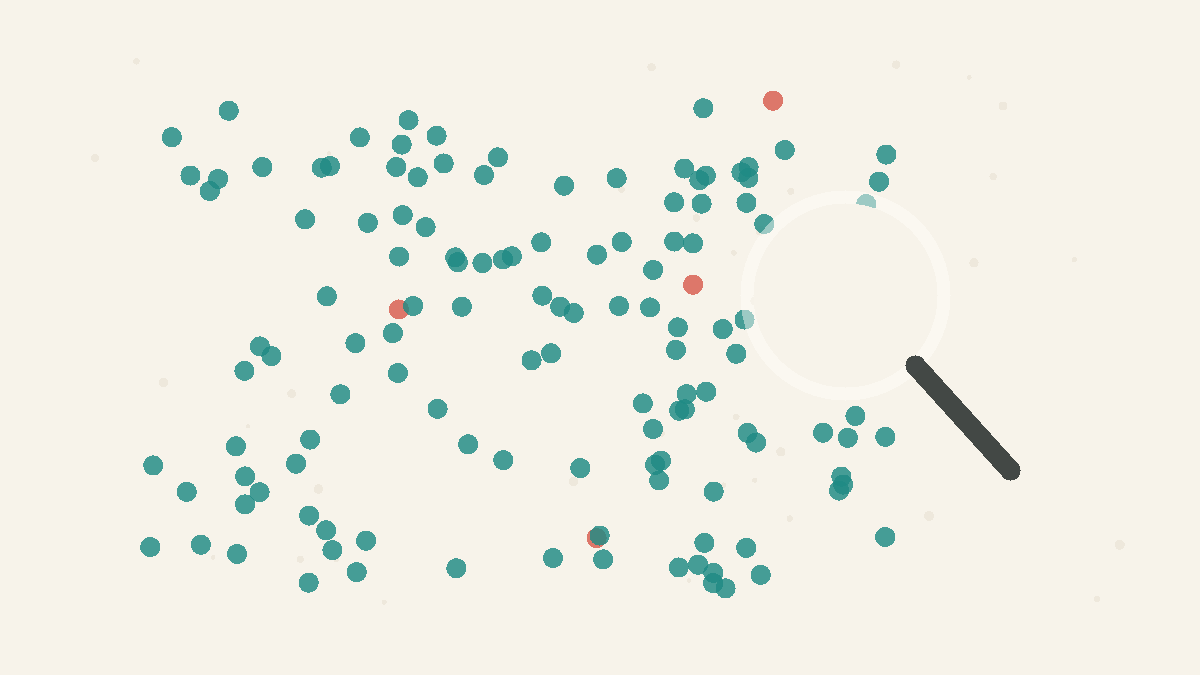
A is the that something is true before you look at the new evidence. When the base rate is very low, most cases begin in the not-this category. That starting point matters. A positive signal has to overcome the large number of ordinary cases that can accidentally trigger it. Ignoring the base rate makes rare events feel much more common after a single alert than they really are.
Accuracy is not the whole story
A test can be impressive in isolation and still disappoint in a rare setting. Suppose a condition affects 1 in 1,000 people and a test wrongly flags 1 percent of healthy people. In 100,000 people, there are about 100 true cases but about 999 false alarms. The false-positive rate is small, yet the healthy group is so large that it can dominate the positive results.
Think in natural counts
Percentages often hide the denominator, so rare-event reasoning becomes foggy. Natural counts make the situation visible. Out of 10,000 people, how many would actually have the condition? How many healthy people would be flagged? How many positives would be true? This count-based view is usually clearer than formulas because it shows the competition between true positives and false positives in the same frame.
Apply it beyond medical tests
Base-rate thinking applies to spam filters, fraud alerts, hiring signals, security warnings, machine-learning classifiers, and news about rare dangers. The question is always the same: how common was the target before the signal, and how often does the signal appear when the target is absent? A strong clue can still be weak evidence when the thing it points to is extremely rare.
FAQ
Why can a positive test be wrong more often than right?
When the condition is rare, there are many more non-cases than cases. Even a small false-positive rate can create many alarms from that large non-case group.
What should I ask after seeing a rare-event alert?
Ask for the base rate, the true-positive rate, and the false-positive rate. Then convert them into counts for a fixed group size before judging the alert.
Core Concepts
Base Rates
The background frequency of something before you consider new evidence. A strong signal can still produce many false alarms when the thing being tested for is rare, because there are many more non-cases than cases. Good reasoning combines the new signal with the base rate.
Conditional Probability
The probability of something after new information changes what is still possible. The important move is to update the denominator: cases ruled out by the new information should no longer be counted. Many mistakes happen when people keep using the original odds after the situation has narrowed.
See it in action
A one-in-a-million match is not a one-in-a-million chance of innocence
Multiply the match rate by the population searched: a 1-in-a-million trait in a city of 9 million still leaves about nine innocent matches, so the match narrows the field — it does not settle it.
A good test can still scare too many people
Accuracy is not enough. You also need the base rate of the thing being tested.
Quick Check
A trait matches 1 in a million people. In a city of 9 million, why isn't a single match strong proof of guilt?
A
Because the test is wrong 1% of the time.
B
Because 1 in a million is actually common.
C
About 9 innocent people in the city would match too.