Fact
A good test can still scare too many people
When a condition is rare, most positive test results can still be false positives.
Accuracy is not enough. You also need the base rate of the thing being tested.
By the Math Says Yes editorial team
Human-reviewed under our source and correction standards.
How we review content
THE TRAP
A test with 99% sensitivity and specificity sounds decisive. That ignores how rare the condition was before testing.
What this shows
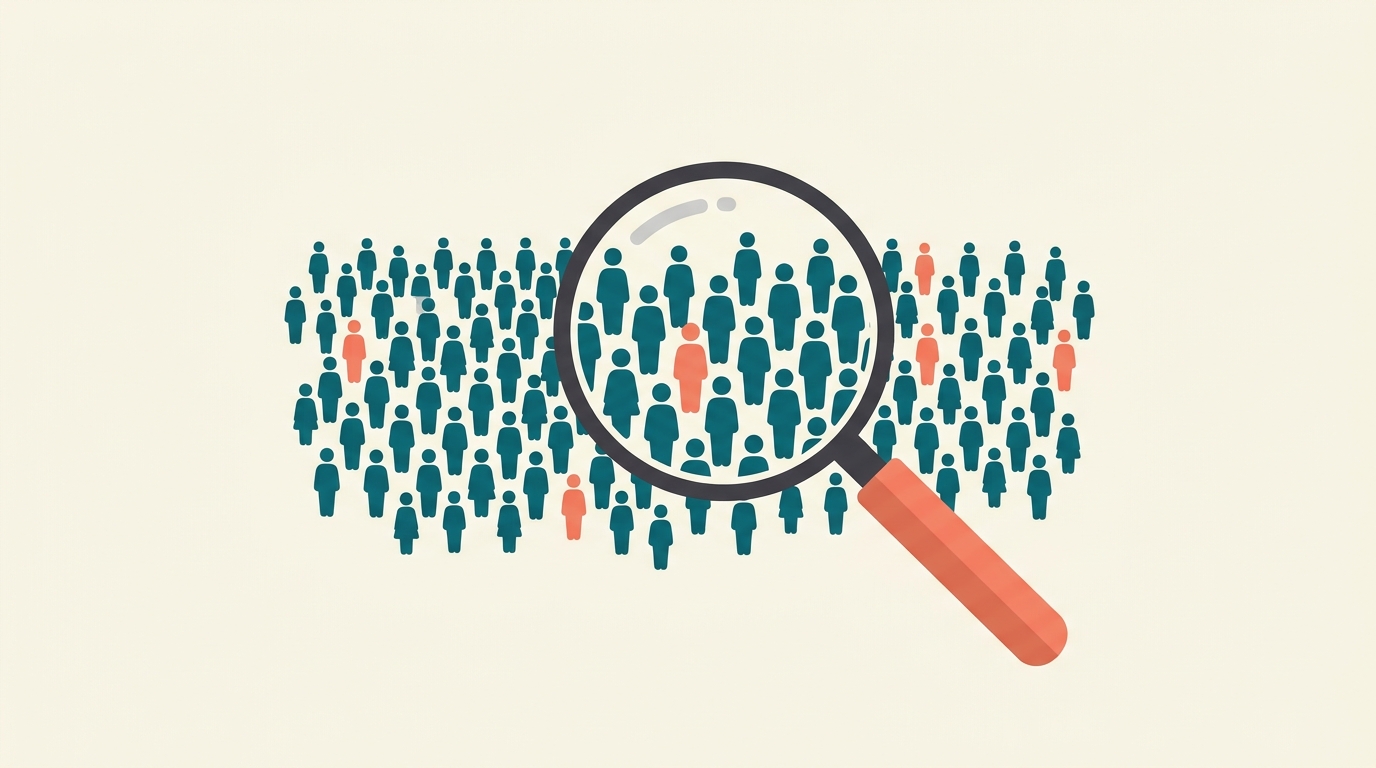
A positive test result cannot be read in a vacuum: judging it without the starting frequency of the thing you are looking for is the base-rate fallacy. If the condition is rare, the test is applied to far more people without the condition than people with it. Even a low false-positive rate can then create many alarms, because it is multiplied across the much larger non-case group.
What the Numbers Show
true positives
10 people
false positives
100 people
Illustrative: among 10,000 people, 1-in-1,000 prevalence plus 99% sensitivity and specificity yields about 10 true and 100 false positives.
Why intuition fails
The phrases 99% sensitive and 99% specific pull attention toward the test and away from the being tested. People often ask the wrong conditional question: how often is the test positive when the condition is real? The decision question is different: among people with a positive result, how many truly have the condition? Those probabilities are not interchangeable. The supplies the missing denominator.
Worked example
Imagine testing 10,000 people for a condition that affects 1 in 1,000. About 10 people have it and about 9,990 do not. If the test catches 99% of true cases and falsely flags 1% of healthy people, it finds about 10 true positives but also about 100 false positives. Only about 10 of the 110 positive results are real: the positive group is mostly false alarms, because most flagged people came from the much larger healthy group.
How to use it
Turn the percentages into counts before reacting. Pick a clear size, estimate how many cases the implies, then apply the test's true-positive and false-positive rates to the case and non-case groups separately. Finally, compare the true positives with all positive results. This small table often makes the answer obvious in a way raw percentages do not.
What people get wrong
A '95% accurate' test does not a positive result gives you a 95% of having the condition. That reading quietly reverses the conditional: tells you how often the test is positive when the condition is present, not how likely the condition is given a positive result. To get the second number, you must combine the result with how common the condition was before the test — and rare things can stay rare even after strong evidence points toward them.
When it applies
Base rates matter whenever evidence is used to identify a rare condition, event, customer behavior, fraud case, or legal suspect. The pattern is strongest when the thing being detected is rare and false positives are not almost impossible. The practical fix is to translate percentages into natural frequencies: out of 10,000 people, how many true positives and false positives should we expect?
Source note
Gigerenzer and Hoffrage showed that frequency formats improve Bayesian reasoning, and the page's main advice follows from that: explain test results as counts out of a , not only as , , or abstract percentages.
Try It
Base rate & false positives
400 people tested, one dot each. The test catches 99% of cases and wrongly flags 1% of healthy people.
Out of 400 people, the test flags about 6. How many of them are actually sick?
At 2 in 400 sick, the test raises 6 alarms — 2 real, 4 false. A positive result is real 33% of the time.
FAQ
What is the base-rate fallacy?
It is the mistake of ignoring how common something was before new evidence arrived. If the event is rare, the starting odds are low. A strong signal can raise those odds, but it has to overcome the large number of non-cases that can still produce false alarms.
Can most positive results really be false?
Yes, when the tested condition is rare enough and the test is applied broadly. A tiny false-positive rate across thousands of people without the condition can create more positive results than the true cases create.
How do I avoid the mistake?
Use counts instead of only percentages. Start with a population, split it into cases and non-cases using the base rate, apply the test's error rates, and then ask what share of all positive results are true positives.
Quick Check
A condition affects 1 in 1,000 people. A test has 99% sensitivity and specificity. Why can a positive still likely be false?
A
False alarms from the much larger unaffected group outnumber true cases.
B
99% accuracy means 99% of positive results are wrong.
C
The test becomes less accurate for rare conditions.
Sources
Base rate fallacy
Secondary explainer
Wikipedia · Accessed 2026-06-14
How to improve Bayesian reasoning without instruction: Frequency formats
Primary source
Psychological Review · Accessed 2026-06-20
Know someone who'd like this?
Read next

A one-in-a-million match is not a one-in-a-million chance of innocence
When a forensic trait matches 1 in a million people, a big enough population still holds many innocent matches — the match probability is not the probability of innocence.
Concepts
Base Rates
The background frequency of something before you consider new evidence. A strong signal can still produce many false alarms when the thing being tested for is rare, because there are many more non-cases than cases. Good reasoning combines the new signal with the base rate.
Conditional Probability
The probability of something after new information changes what is still possible. The important move is to update the denominator: cases ruled out by the new information should no longer be counted. Many mistakes happen when people keep using the original odds after the situation has narrowed.