Lesson
Averages Stabilize in Shape
Individual observations can be messy, skewed, or spiky, yet averages of many independent observations often settle into a predictable bell-shaped pattern.
By the Math Says Yes editorial team
Human-reviewed under our source and correction standards.
How we review content
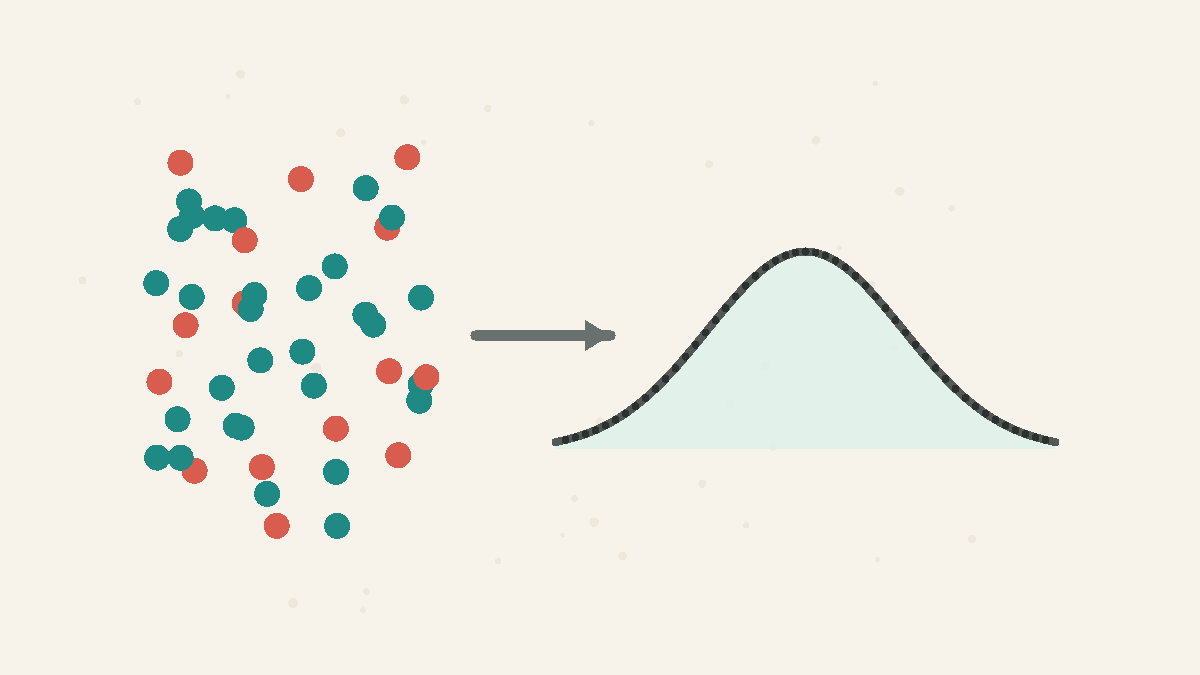
Individuals are messy
Raw data often has a strange shape. Purchases are skewed, wait times have long tails, website visits spike, and household sizes are lumpy. If you draw one observation, that mess matters. But many decisions use averages: the sale per day, the average wait across many calls, or the average response in a treatment group. Averages behave differently from the individual observations they summarize.
The theorem's promise
The says that, under broad conditions, averages of many independent observations have a sampling that approaches a bell shape. The original data do not have to be normal. What matters is that no single observation dominates the and that the observations are not all locked together. This is why normal-based uncertainty formulas appear in so many places: they are often about averages, not individuals.
What it does not promise
The theorem is powerful, but it is not a license to ignore the data. It does not make every small normal. It does not fix dependence, strong selection , or measurements with no stable . It also does not say the original is bell-shaped. The shape belongs to repeated sample averages. When the sample is tiny, the tail is extreme, or the observations are related, the approximation can be poor.
How to use it
Use the as a reason to model averages cautiously, not blindly. Check the , , and whether outliers can dominate the . If those conditions look reasonable, a bell-shaped uncertainty range around the average may be useful even when the raw data are not bell-shaped. If the conditions fail, use simulation, robust summaries, or methods designed for the actual shape.
FAQ
Does the central limit theorem mean all data are normal?
No. It concerns the distribution of averages across repeated samples, not the shape of individual observations. The raw data can remain skewed, lumpy, or heavy-tailed.
Why is the central limit theorem useful?
It explains why averages from many independent observations often have predictable uncertainty. That makes confidence intervals, standard errors, and many statistical tests workable in everyday data analysis.
Core Concepts
Central Limit Theorem
The central limit theorem says that averages of many independent, similar-sized random influences tend to form a bell-shaped sampling distribution, even when the original data are not bell-shaped. It explains why averages are often more predictable than individual observations.
Standard Error
Standard error is the typical sampling wobble of an estimate such as a mean. For independent observations, the standard error of a mean shrinks with the square root of the sample size, so cutting the error in half usually takes four times as much data.
Quick Check
What does the central limit theorem help explain?
A
Outliers disappear automatically in small samples.
B
Averages of many independent observations tend toward a bell shape.
C
Every real-world dataset is bell-shaped.