Glossary term
Z-Score
How many standard deviations a value sits above or below the mean.
Visual intuition
mean
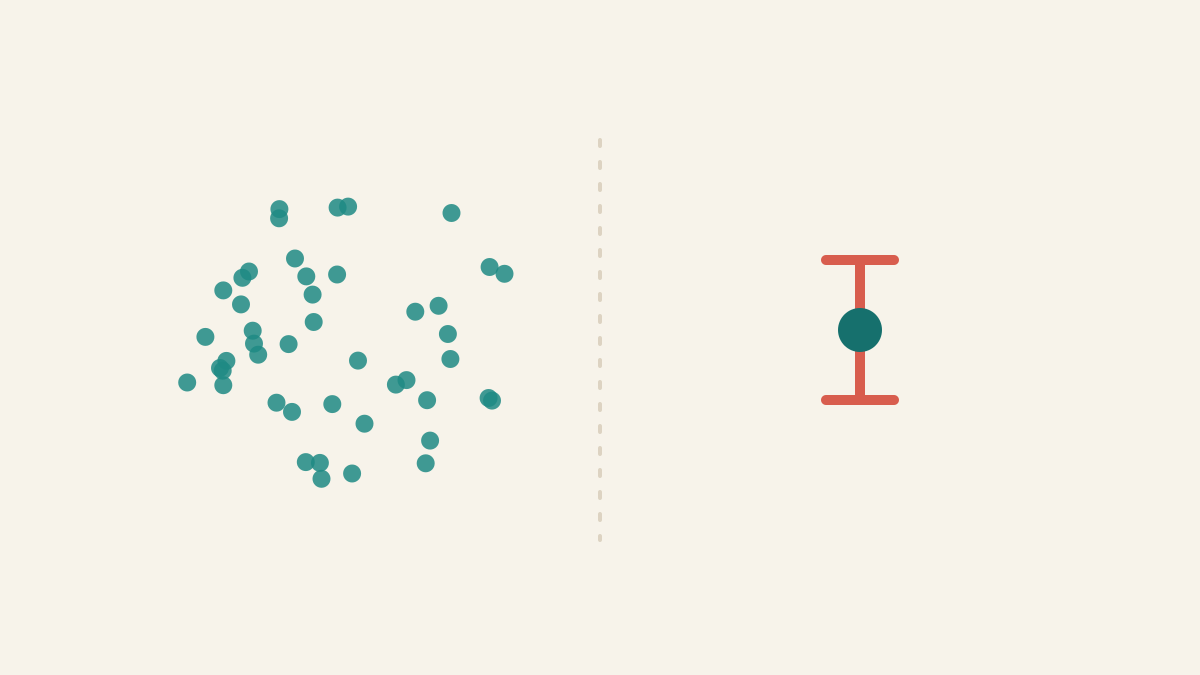
A z-score counts halo-widths from the mean peg
The peg marks the mean; the shaded halo spans one standard deviation. A value's z-score is how many of those halo-widths it sits from the peg — dots inside the halo are within z of 1, and a dot two halo-widths out has z = 2.
Formula
z = (value - mean) / standard deviation
Example
Exam 70, 8: a score of 86 has z = (86 - 70) / 8 = 2 — two standard deviations above the class mean, roughly the top 2% if scores are bell-shaped (illustrative numbers).
How It Works
'167 cm' means nothing without context; 'z = -0.4' places you — a bit below the crowd's , measured in that crowd's own spread. A z-score converts any value into standard-deviation units: subtract the mean, divide by the . Positive means above the mean, negative below, and the size says how unusual: in bell-shaped data about 68% of values fall within z of plus-or-minus 1 and 95% within plus-or-minus 2, so z = 3 is a genuine . Because the units cancel, z-scores put different scales on one footing — you can ask whether your maths result was more unusual than your sprint time.
Concepts
Standard Deviation
Standard deviation describes how spread out individual observations are around their mean. It is about variation in the data itself. Standard error is different: it describes how much an estimate such as the sample mean would vary across repeated samples.
Summary Statistics
Summary statistics compress a dataset into numbers such as the mean, variance, correlation, or regression line. They are useful, but they can hide shape, outliers, clusters, and curved relationships that a graph would reveal immediately.