Lesson
Shared Causes Fake Links
A hidden common cause can make unrelated things move together.
By the Math Says Yes editorial team
Human-reviewed under our source and correction standards.
How we review content
Correlation is a clue, not a cause
When two numbers move together, they may be connected, but the pattern alone does not tell you how. One could cause the other, the direction could be reversed, both could be driven by a third factor, or the relationship could be coincidence. is useful because it points to something worth investigating. It becomes dangerous when it is treated as the end of the investigation rather than the beginning.
Confounders create convincing stories
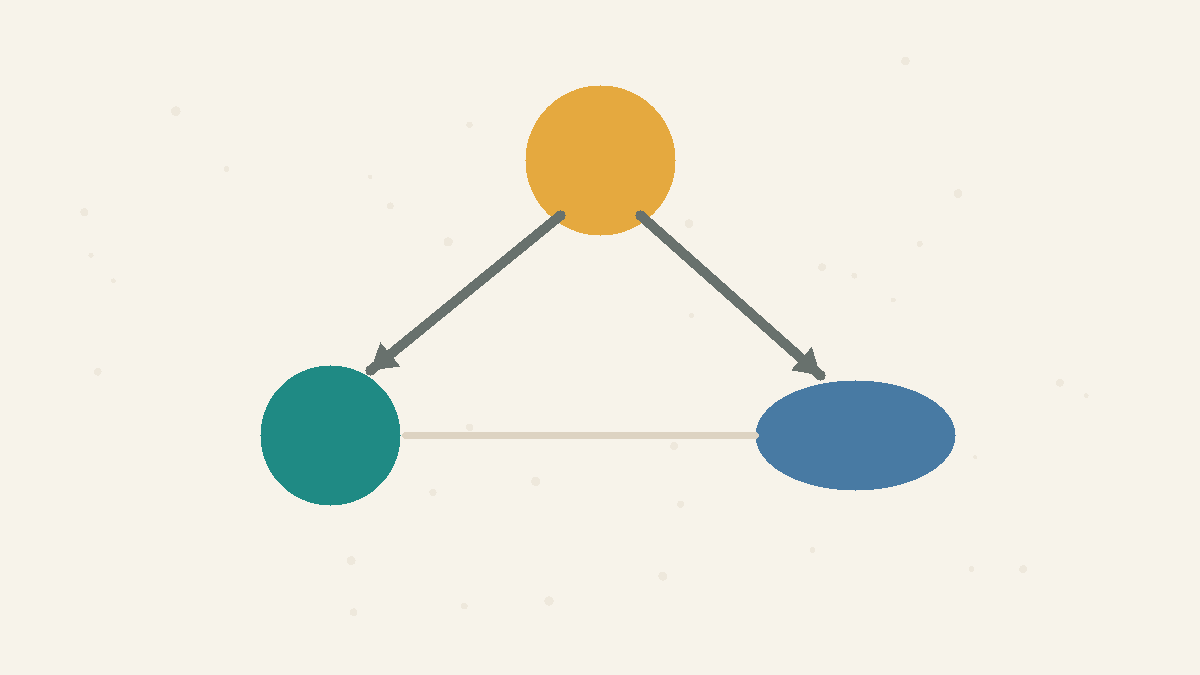
A is a hidden factor that affects both variables you are comparing. Ice cream sales and drownings rise together because warm weather increases both swimming and ice cream buying. Without temperature in the story, the data can tempt you into a false causal link. The same issue appears in health, economics, education, and product metrics whenever groups differ in ways that also affect the outcome.
Look for a fair comparison
To move from toward causation, compare cases that are alike except for the possible cause. Randomized experiments do this by assigning treatment randomly. Natural experiments, matched comparisons, and statistical controls try to approximate the same idea when experiments are impossible. The goal is to remove alternative explanations, not simply to find a stronger-looking chart. A fair comparison asks what would have happened without the cause.
A checklist for causal claims
When you hear that one thing caused another, ask three questions. Did the cause happen before the effect? What else changed at the same time? Is there a where that other explanation is held steady? If the claim cannot answer those questions, it may still be a hypothesis, but it has not earned the status of a causal conclusion.
FAQ
Does correlation ever matter?
Yes. Correlation can reveal patterns worth studying and can support prediction. It just does not prove the causal mechanism by itself.
What is a confounder in simple terms?
A confounder is a third factor that influences both things you are comparing, making them move together even when neither one directly causes the other.
See it in action
Correlation vs causation: why moving together is not proof
Correlation is a pattern. Causation is a claim about mechanism. To move from one to the other, you need timing, a fair comparison, and alternative explanations ruled out.
Does ice cream cause drownings?
Warm weather can raise ice-cream demand and time spent in or around water. That shared seasonal influence can make two lines move together without ice cream causing drowning.
Quick Check
Ice-cream sales and drownings rise together. What is needed before claiming that one causes the other?
A
An even stronger correlation
B
A fair comparison that rules out heat and other confounders
C
Matching units on both axes