Collection
Big Number Intuition
Hands-on examples that make huge numbers and runaway growth feel concrete instead of abstract.
Human number sense tops out around a few thousand; past that, everything reads as "a lot". A million seconds is 12 days. A billion seconds is 32 years. If that gap surprises you, the flattening has already happened, and it quietly distorts how you read budgets and news headlines.
This collection gathers the Math Says Yes pages that rebuild the missing sense of scale. Rice doubling on a chessboard shows how exponential growth outruns any straight line. The Rule of 72 turns the same curve into a shortcut you can run in your head at the bank. Estimating garages in a city, or trees against stars, shows how far rough numbers and honest ranges can carry you.
None of it needs formulas beyond arithmetic. The goal is a working feel for magnitude: count the zeros first, and treat any lonely giant number as a question rather than an answer.
Feel the gap between million and billion
Start with time. A million seconds pass before your next weekend ends, while a billion seconds reach past a mortgage. Once the gap is felt in days and years, transfer it: a billion-dollar company is a thousand times the million-dollar one, not its slightly bigger sibling.
One shortcut worth memorizing
Divide 72 by a steady growth rate and you get the approximate doubling time: 6% doubles in about 12 years, 9% in about 8. The exact constant is 69.3, but 72 divides so cleanly that the rough version wins in practice. It works for savings and for anything else that compounds steadily.
Estimate before you trust
A count you build yourself beats a count you swallow whole. The garages page walks through Fermi estimation step by step; the trees-versus-stars page shows scientists doing the same with satellites and sample plots, open about their error bars. Both end in the same habit: ask for the range, not just the number.
Featured Facts
Nature & Scale
4 min · easy

A million seconds vs a billion seconds
A million seconds is about 12 days. A billion seconds is about 32 years.
Nature & Scale
4 min · easy

One grain of rice can bankrupt an empire
Place one grain on a chessboard's first square and double it each square — the last square alone reaches 2⁶³ grains.
Nature & Scale
4 min · easy
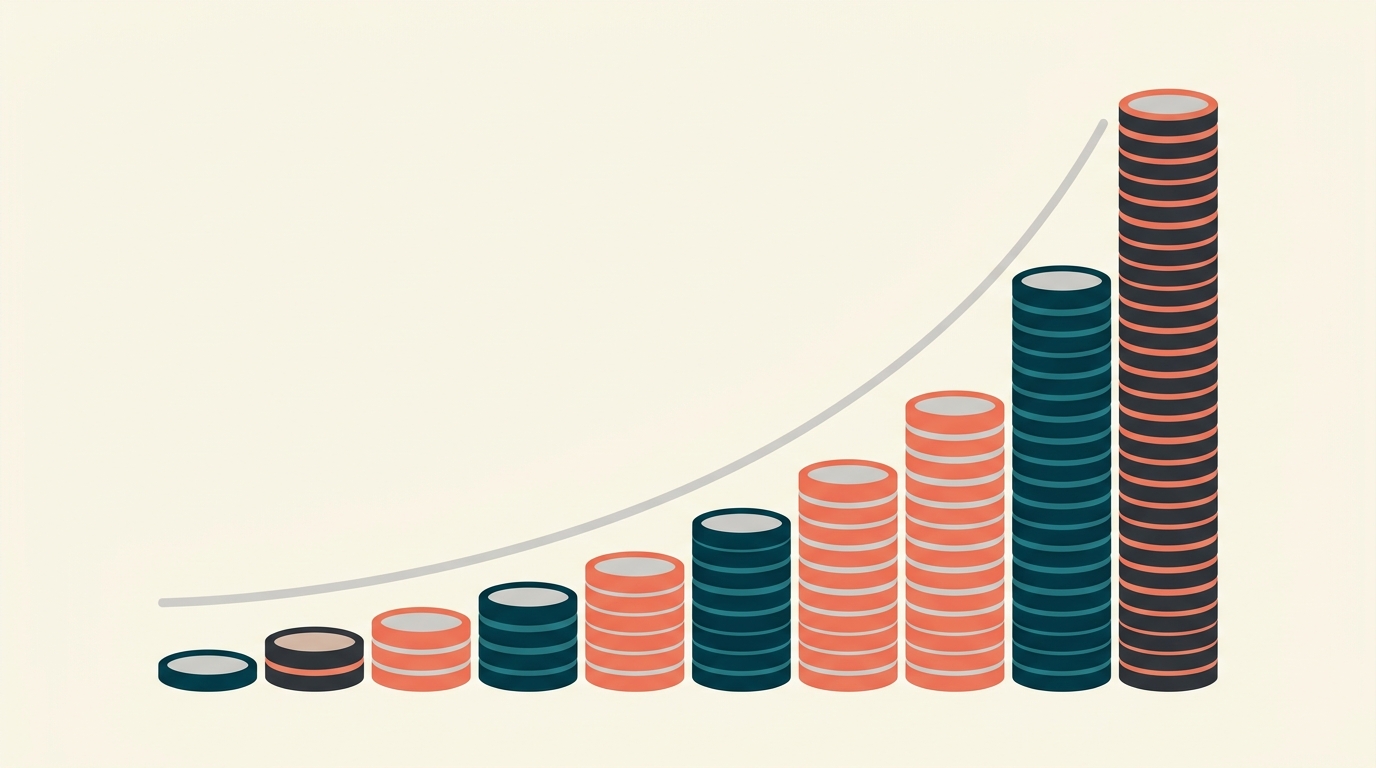
Money doubles slowly, then all at once
Divide 72 by the yearly growth rate and you get the years it takes to double — a trick that hides a steep curve.
Nature & Scale
4 min · easy

Earth may have more trees than the Milky Way has stars
A 2015 Nature study estimated about 3.04 trillion trees on Earth, far above common estimates for stars in the Milky Way.
Nature & Scale
4 min · easy

premium
A parking garage can disappear into garbage math
A city can produce volumes of trash that sound impossible until you break the estimate into people, bags, and space.
Lessons



Concepts
Exponential Growth
Quantities that grow by a constant percentage multiply rather than add, so each step is bigger than the last. The total stays deceptively flat for a long time, then erupts. Doubling is the clearest case: every step is as large as everything that came before it combined.
Orders of Magnitude
A factor-of-ten step. We handle small additive differences well but badly underestimate how far apart numbers are when they span many tens — which is why a million and a billion feel similar even though one is a thousand times the other.
Logarithmic Scale
A way of measuring multiplicative growth, where equal distances mean equal ratios instead of equal differences. Moving from 1 to 10 is the same size jump as moving from 10 to 100 because both are times ten. Log scales are useful when quantities span several orders of magnitude.
Uncertainty
The honest range left after measurement limits, model choices, and missing information. A single number can be useful as a midpoint, but decisions usually need plausible low and high values too. Good estimates state the assumptions that would move the answer.