Lesson
Precision Has Square-Root Returns
More data helps, but random error shrinks slowly: to halve the noise in an average, you usually need four times as many observations.
By the Math Says Yes editorial team
Human-reviewed under our source and correction standards.
How we review content
The square-root rule
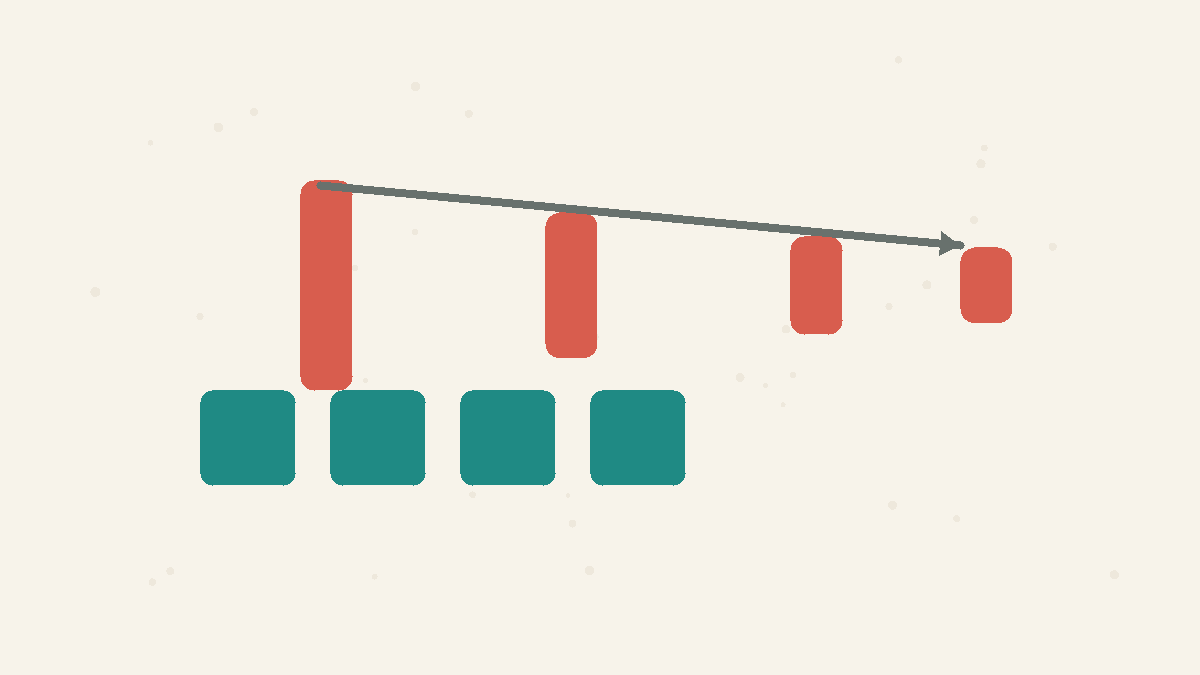
When independent observations are averaged, random errors partly cancel. The cancellation is real, but it follows a square-root pattern. If you multiply the by 4, the is cut about in half. If you multiply it by 100, the standard error is cut by about 10. That is why the first extra observations help a lot, while later improvements become increasingly expensive.
Why small samples mislead
A tiny has a wide cloud of possible estimates. It can land close to the truth, but it can also land wildly high or wildly low by ordinary . Because the error is large, small samples dominate lists of extremes: best towns, worst hospitals, hottest funds, or most dangerous roads. Some entries are genuinely unusual, but many are just noisy estimates that have not had enough observations to calm down.
Power is precision with a job
Statistical power asks whether a study is precise enough to detect an effect of a given size. If the true effect is small and the is noisy, the study may miss it. That does not prove the effect is absent; it may only prove the study was too blunt to see it. Power turns the square-root rule into a design question: how much data is needed before the signal has a fair to rise above the noise?
How to use it
Before trusting an estimate, ask whether the is large enough for the decision being made. For rough direction, a modest sample may be fine. For tiny differences, medical safety, or high-stakes ranking, the sample may need to be much larger than intuition expects. Remember the cost curve: twice as much precision does not take twice as much data. It usually takes about four times as much.
FAQ
Why does halving error take four times more data?
For many independent averages, standard error is proportional to 1 divided by the square root of sample size. To make that error half as large, the sample size must be four times larger.
Does a non-significant result prove there is no effect?
Not necessarily. A low-powered study can miss a real effect because the sample is too small or noisy. You need the interval, effect size, and study power to judge what the null result means.
Core Concepts
Law of Large Numbers
As a sample grows, its average gets closer to the true average and random swings shrink, roughly in proportion to 1 over the square root of the sample size. Small samples can land far from the truth purely by chance, which is why a handful of observations is so easy to misread.
Standard Error
Standard error is the typical sampling wobble of an estimate such as a mean. For independent observations, the standard error of a mean shrinks with the square root of the sample size, so cutting the error in half usually takes four times as much data.
Statistical Power
Statistical power is the chance that a study will detect an effect of a given size if that effect is real. Low-powered studies can miss real effects, while very large studies can detect effects too small to matter in practice.
See it in action
Standard error vs standard deviation: spread vs precision
Standard deviation is about variability in the data. Standard error is about variability in an estimate across repeated samples.
Statistical power: a small study can miss a real effect
Statistical power is the chance a study will detect a real effect of a chosen size. Low power makes null results hard to interpret.
Twice as much data does not make estimates twice as precise
Standard error shrinks with the square root of sample size, which is why small samples wobble and very precise estimates get expensive fast.
Quick Check
A mean becomes more precise after collecting more observations. Which quantity should usually shrink?
A
The standard error
B
Both must shrink equally
C
The standard deviation must shrink