Glossary term
False Positive
A test result that says something is there when it is not — a healthy person flagged as positive.
Visual intuition
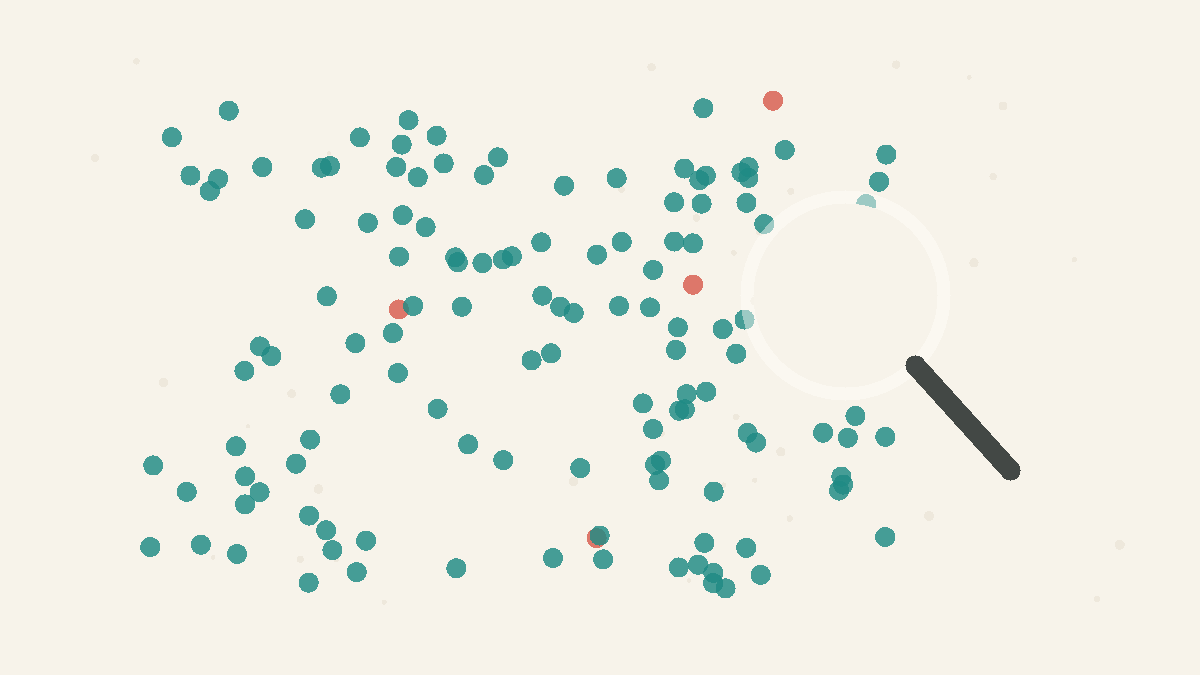
3 in 100
before new evidence
Every alarm among the 97 is a false positive
Only the 3 highlighted people truly have the condition. Any positive result among the other 97 is a false positive — and because the 97 outnumber the 3, false alarms can easily outnumber real ones as the condition gets rarer.
Formula
false-positive rate = 1 - specificity
Example
With a 99%-sensitive, 99%-specific test and a 1-in-1,000 condition, testing 10,000 people yields about 10 true positives and about 100 false positives — a positive result is real only about 9% of the time.
How It Works
A false positive is an alarm without a fire: the test says positive, the truth says no. Every false positive comes from the group without the condition — and that group is usually the overwhelming majority, so even a small false-alarm rate, multiplied across many healthy people, produces piles of them. Screen 10,000 people for a 1-in-1,000 condition with a 99%-specific test and about 100 healthy people get flagged, against only about 10 true positives: most alarms are false. In hypothesis testing, the same mistake — flagging an effect that is not there — is called a type I error.
Concepts
Base Rates
The background frequency of something before you consider new evidence. A strong signal can still produce many false alarms when the thing being tested for is rare, because there are many more non-cases than cases. Good reasoning combines the new signal with the base rate.
Conditional Probability
The probability of something after new information changes what is still possible. The important move is to update the denominator: cases ruled out by the new information should no longer be counted. Many mistakes happen when people keep using the original odds after the situation has narrowed.
Related Facts
Risk & Decisions
4 min · medium

A good test can still scare too many people
When a condition is rare, most positive test results can still be false positives.
Risk & Decisions
4 min · medium

A one-in-a-million match is not a one-in-a-million chance of innocence
When a forensic trait matches 1 in a million people, a big enough population still holds many innocent matches — the match probability is not the probability of innocence.