Fact
Relative risk vs absolute risk: the difference that changes decisions
Relative risk tells you how many times bigger a risk became. Absolute risk tells you how many extra people are affected.
Relative risk can make small changes sound large. Absolute risk puts the change back on a real scale, such as 2 in 100 becoming 3 in 100.
By the Math Says Yes editorial team
Human-reviewed under our source and correction standards.
How we review content
THE TRAP
Reacting to the percentage change before asking how big the starting risk was.
The short difference
is a ratio: it says one risk is 1.5 times, 2 times, or 50% higher than another. is a level or difference: it says 2 in 100 became 3 in 100, or one extra person per 100 was affected. Relative wording is compact and useful for comparison, but it hides the baseline. Absolute wording restores the denominator, which is what most decisions need.
Quick Comparison
Relative risk
Absolute risk
What it answers
How many times larger or smaller is one risk than another?
How many people are affected before and after?
Common mistake
Hearing a big percentage and assuming many people are affected.
Ignoring the proportional change after seeing only counts.
Use when
You compare strength of association after the baseline is visible.
You judge scale for a real decision.
What the Numbers Show
2 people affected before
1 additional person affected
97 people not affected
The same change shown as people: 2 affected before, 3 after — just 1 additional person in 100.
Worked example
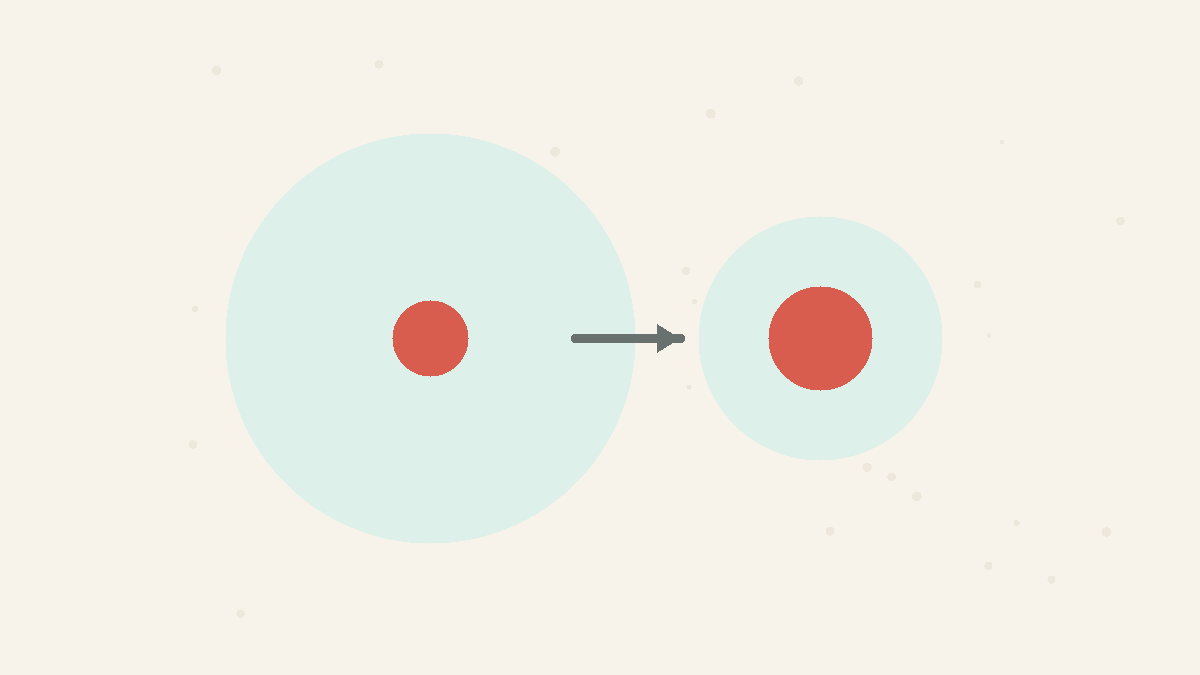
If a risk rises from 2 in 100 to 3 in 100, the is 50%, because one extra case is half of the original two cases. The is 1 percentage point, or one extra case per 100 people. Both descriptions are mathematically true. They feel different because the relative version emphasizes the proportional change, while the absolute version shows the real number of additional cases.
What people get wrong
Hear “risk doubled” and the mind pictures a crowd of new cases. A risk that doubles may still be rare if it starts at 1 in 10,000. The opposite can happen too: a modest relative change can be important when the baseline is common. You cannot judge the size of a risk change from the relative phrase alone. You need the before-and-after absolute risks on the same denominator.
When it applies
This distinction matters in health studies, drug benefits, side effects, safety claims, product metrics, and public-risk headlines. Use to compare strength across groups after the baseline is known. Use to decide whether the change is meaningful for a person or . The clearest reporting usually gives both: relative change for pattern, absolute change for scale.
Source note
Trevena and colleagues' review focuses on communicating evidence to patients, including the value of absolute formats and natural frequencies. The relative-risk reference supplies terminology. The page uses a simple illustrative 2% to 3% move because it isolates the communication problem: the same change can sound dramatic or modest depending on the scale shown.
Try It
Relative vs. absolute risk
Keep the group fixed at 100 people, then change how many are affected before a +50% increase.
People affected before
2 of 100 people
2
affected before, of 100
3
affected after +50%, of 100
The group stays fixed at 100 people. Starting with 2 affected, "+50%" means 3 affected — 1 extra person in the same 100. Relative risk describes the proportional change; absolute risk counts the extra people.
FAQ
Which is more important, relative risk or absolute risk?
For decisions, absolute risk is usually more important because it shows the real scale. Relative risk is useful after the baseline is visible.
Is a 50% higher risk always scary?
No. If the baseline risk is tiny, a 50% increase can still be tiny in absolute terms. Ask for the count before and after.
Quick Check
A side effect starts at 2 in 100 people. A study says the risk is 50% higher. What is the new risk?
A
50 in 100
B
2 in 50
C
3 in 100
D
52 in 100
Sources
A systematic review on communicating with patients about evidence
Primary source
Journal of Evaluation in Clinical Practice · Accessed 2026-06-20
Relative risk reduction
Secondary explainer
Wikipedia · Accessed 2026-06-14
Know someone who'd like this?
Read next

A one-in-a-million match is not a one-in-a-million chance of innocence
When a forensic trait matches 1 in a million people, a big enough population still holds many innocent matches — the match probability is not the probability of innocence.
Related Comparisons
P-value vs confidence interval: what each one tells you
P-values and confidence intervals answer different questions. Use the p-value for evidence against a null model, and the interval for the size and uncertainty of the effect.
Mean vs median: which average should you use?
Mean and median are both measures of center, but the mean is pulled by extreme values while the median tracks the middle observation.
Correlation vs causation: why moving together is not proof
Correlation is a pattern. Causation is a claim about mechanism. To move from one to the other, you need timing, a fair comparison, and alternative explanations ruled out.
Standard error vs standard deviation: spread vs precision
Standard deviation is about variability in the data. Standard error is about variability in an estimate across repeated samples.
Concepts
Absolute vs Relative Risk
A relative change ('50% more', 'doubles your risk') hides how big the underlying risk actually is. A large relative increase on a tiny base rate is still tiny. Always ask for the absolute numbers — how many in 100 before and after — not just the percentage change.
Base Rates
The background frequency of something before you consider new evidence. A strong signal can still produce many false alarms when the thing being tested for is rare, because there are many more non-cases than cases. Good reasoning combines the new signal with the base rate.
Comparing Risks
Putting different dangers on one common scale — like the micromort, a one-in-a-million chance of death — lets you compare activities honestly, instead of ranking them by how frightening they feel.